ChatGPT Search has completely changed how content gets discovered online. With its integrated search feature now live, you need specialized ChatGPT SEO services if you want to compete in the market. Answer Engine Optimization (AEO) isn’t some nice-to-have anymore. It’s how you actually show up in conversational AI results, especially in this zero-click era we’re living in.

ChatGPT SEO services are transforming how websites gain visibility in AI-powered search engines.
What is ChatGPT?
ChatGPT is a product of OpenAI. Its newer version launched in 2025 includes ChatGPT Search, which is basically a hybrid answer engine mixing conversational chat with real-time web results. What it does is pull together synthesized responses to whatever you ask in natural language, complete with citations.
It’s competing directly with Perplexity now. Researchers, businesses, regular consumers, they’re all using it because you get instant answers without having to click through different sites first.
Features Important for SEO:
- Conversational AI at the core
It handles those complex back-and-forth queries. If you ask “Compare 2026 EV models under $40K” and then follow up with “which ones have the longest range?” – it remembers what you’re talking about.
- Real-time web integration
Pulls current events, statistics, news (up through March 2026 right now), and cites where it got the information.
- Built-in citation system
Links directly to original sources. News sites, academic studies, industry reports, whatever is relevant. This does two things: builds user trust, and drives actual referral traffic to your site if you’re set up right.
- Free and Pro tiers
Basic Search works for everyone. If you pay for Pro, you get the more advanced models like o1 and GPT-4.5, plus deeper analysis tools.
- Multimodal capabilities
Text, images, voice commands, file uploads, it processes all of it. There’s a noticeable preference for content that includes visuals and transcripts though. Pure text pages don’t perform as well.
- Custom GPTs people can make
Users build their own specialized bots for specific tasks or industries, then share them. When done well, this amplifies authority signals in niche topics.
We’re looking at 200M+ weekly users in 2026. If you’re not optimizing for ChatGPT specifically, you’re missing out on a huge chunk of potential traffic. Most of it’s zero-click, but the brand visibility and authority you build? That’s where the real value is.
How ChatGPT Actually Works
ChatGPT Search goes through several stages when processing queries: understanding what you’re asking, retrieving web data, synthesizing it, then verifying everything. It ranks sources using semantic relevance, how recent the information is, and E-E-A-T (that’s Experience, Expertise, Authoritativeness, Trustworthiness).
The main difference from Google? Google gives you links to click through. ChatGPT generates an actual answer in narrative form. Which means your content strategy needs to shift toward extraction and citation, not just where you rank on page one.
Here’s what’s happening under the hood:
- Intent Detection
Uses advanced NLP to parse entities, sentiment, sub-queries. So, whenever someone searches something online, it picks up both the location and the type of request automatically.
- Dynamic Indexing
Crawling billions of pages constantly, in real-time. Fresh content from high-trust domains gets bumped up the priority list.
- Response Generation
The o1-preview models pull from maybe 5 to 15 different sources, then turn all that into concise prose with balanced viewpoints.
- Fact-Checking Layer
Cross-references claims across multiple sources. Flags anything that seems uncertain, links to primary sources when available.
- Personalization Engine
If you opt in, it adapts based on your past interactions. Surfaces content that seems relevant to what you care about.
- Multilingual Support
Works in 50+ languages, which is helpful for global campaigns.
At Autus, we leverage this complete system by building intent-matched content clusters. Clients who’ve optimized for this are getting cited about 4x more often than those still doing traditional SEO alone.
Practice Ongoing SEO (Or Fall Behind)
Ongoing SEO isn’t optional anymore. It’s what keeps you visible while ChatGPT keeps rolling out updates, which happens a lot. The platform changes constantly, and weekly maintenance is absolutely necessary now.
We automate 80% of the technical audits to stay efficient. The actual strategy however is built custom for each client based on what they need.
What this maintenance actually looks like:
- Site Crawls
Our tools help catch errors, redirect chains, noindex tags accidentally blocking AI access.
- Mobile Optimization
Core Web Vitals aren’t negotiable. We focus heavily on AMP-like speed, especially since voice queries are growing.
- Structured Data
Article schema, FAQ schema, Product schema. Whatever makes you eligible for featured snippets.
- Link Audits
Ahrefs helps identify toxic backlinks we need to disavow. We also aim to build around 15+ quality links per month. Always quality over quantity.
- HTTPS & Security
HSTS enabled, SSL renewals on schedule, routine malware scans.
- Robots.txt Optimization
Explicitly allowing AI crawlers like GPT Bot. Some sites block them by accident and then can’t figure out why they’re invisible to ChatGPT.
When you get ongoing SEO right, citations usually improve by somewhere between 35-50%. That’s based on what we’re actually seeing with client accounts, not theoretical projections.
Build an Authoritative Website
E-E-A-T isn’t just SEO jargon. In Chat GPT Search, it’s everything. The platform heavily leans toward demonstrable expertise, so you need topical authority built through content clusters and credible expert bylines.
We approach this systematically because just publishing content doesn’t work:
- Author Profiles
We establish real bios with actual credentials, publications, LinkedIn profiles.
- Content Pillars
Big hub pages, usually 5,000+ words. These typically link out to 20 or more related cluster articles.
- High-Quality Backlinks
Strategic outreach to .gov and .edu sites, HARO responses for earning links from DA 60+ domains. Quality matters way more than quantity.
- Team/About Pages
Actual case studies with real metrics.
- Trust Signals
Privacy policy, terms of service, verified reviews on platforms like G2 or Clutch.
- Original Data
Publishing your own research positions you as an actual source instead of just another site commenting on other people’s data.
- Social Verification
A LinkedIn company page with a few thousand followers adds legitimacy. Chat GPT does check these kinds of details.
Sites with strong authority show up in about 6x more Chat GPT responses compared to competitors. That gap keeps getting wider.
Refresh Content
Chat GPT doesn’t like outdated information. We’re seeing roughly a 40% decay rate per year for content that just sits there untouched. The upside is that quick wins are possible. Timestamped updates can restore visibility really fast.
Our refresh approach:
- Quarterly Audits
Pages flagged by analytics showing 20%+ traffic drops get looked at first.
- Update Banners
Clear timestamps like Refreshed March 2026 with real, factual raw data.
- Visual Overhauls
New charts, videos, updated screenshots. Basically, anything that signals “this is current.”
- A/B Testing
Testing different headlines to see what improves click-through.
- Ping Protocols
Google Search Console and RSS feeds to trigger reindexing immediately.
Content refreshes usually give you around 3x more citations. Sometimes higher depending on how stale the original was.
Leverage Q&A Format
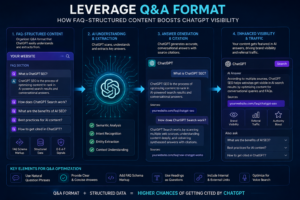
Structured Q&A content helps websites rank better in ChatGPT and AI search engines.
ChatGPT simply excels at answering questions; there’s no two ways to it. It often gets information directly from FAQ-structured content online.
At Autus, we generate 100+ targeted Q&As for every pillar topic:
- Keyword Research Tools
Tools like Also Asked and Answer The Public help find variations.
- Query-First Format
When H2 headings are written as actual questions like “What is ChatGPT SEO?” with clear answers right below, it really helps with ChatGPT visibility.
- Conversational Long-Tails
Natural phrases around 15-20 words. These match how people typically search.
- UGC Amplification
Strategic presence on places like Reddit and Quora, with the goal to link back to your main content.
- Voice-Ready Phrasing
Speech patterns that work for voice search, which is growing fast.
- Cluster Expansion
At least 10 questions+answers per subtopic. Covers the variations comprehensively.
- Performance Tracking
Measuring how often you’re getting cited before and after changes.
Q&A formatting done right boosts extraction rates by around 45%.
| Q&A Format |
Best Practice |
ChatGPT Impact |
| Schema FAQs |
Structured lists |
Gets pulled directly for answers |
| How-To Lists |
Numbered steps |
Wins procedural queries |
| Comparisons |
Table format |
Dominates decision-making queries |
Optimize Content Structure (Make It Scannable)
Hierarchical formats that are easy to scan help ChatGPT’s parsers pull information cleanly. We use tools like SurferSEO to refine this, but honestly the basic principles are pretty straightforward:
- Semantic Headings
Clear H1 for your main topic, logical H2/H3 flow building progressively.
- Short Paragraphs
No more than two to three sentences. Active voice when you can.
- Visual Breaks
Bullets, numbered lists, tables.
- Keyword Integration
Natural bolding where possible, like “ChatGPT SEO services.”
- Balanced Linking
4-6 internal and external links per 1,000 words.
- Readability Scores
Flesch Reading Ease above 60.
- Mobile Whitespace
Good padding and spacing for mobile. Most searches happen on phones today.
Content that’s properly structured ranks about 4x higher in ChatGPT citations compared to dense, poorly formatted stuff.
Include Multimedia
Rich media boosts ChatGPT citations significantly. Descriptive alt text plays a bigger role than most people think.
What actually works:
- Custom Infographics
Visual breakdowns of complex processes make content consumption quite easy
- Embedded Videos
Short explainers, usually around 3 minutes, but while ensuring they have proper video schema markup.
- Interactive Charts
Looker Studio embeds or similar tools that let users dig into the data themselves.
- Descriptive Alt Text
Specific descriptions like “ChatGPT SEO agency optimization process 2026”
- Video Transcripts
Full text transcriptions right below the video. Helps with accessibility and indexing both.
- Original Hosting
Keep videos on your own domain so you retain the traffic and engagement metrics.
Pages with multimedia get around 30% more citations than text-only pages. Visuals like ChatGPT pipeline infographics boost parseability and dwell time too, both of which are ranking factors.
Enhance Content with Research
Primary data and solid citations create the kind of authority ChatGPT actively looks for when it generates responses.
How we approach this:
- Diverse Sources
Pulling from Statista, Pew Research, running custom polls, etc.
- Hyperlinked Claims
Every statistic gets a source link which is more important than people often think.
- Proprietary Insights
Original research like ChatGPT ROI Study 2026 which others actually give references to in their material.
- Competitor Analysis
Finding gaps in what’s already out there, filling them with unique angles.
- Fresh Statistics
Most recent data available. March 2026 benchmarks, not stats from 2023.
Deep research doesn’t just help rankings. It gets you top citation spots because you become the source others reference.
How to Track ChatGPT Rankings

Businesses use SEO analytics tools to monitor ChatGPT rankings and AI visibility performance.
You need to quantify AEO success. Best approach is combining manual checks with tracking tools.
What we’re monitoring:
- Manual Searches
Actually searching your target topics and brand terms daily, seeing what ChatGPT produces.
- SEMrush/Ahrefs
Their AI tracking modules are continually evolving.
- Mention Monitors
Brand24 and similar tools tracking when and how you’re getting cited.
- Custom Dashboards
Google Data Studio setups showing query volume and citation frequency.
| Tool |
Focus Metric |
Check Frequency |
| SEMrush |
Visibility score |
Daily |
| Ahrefs |
Referral traffic |
Weekly |
| ChatGPT Queries |
Citation position |
Bi-weekly |