


Google has once again shaken the SEO world with its March 2026 Spam Update, and if you’ve noticed sudden ranking fluctuations, traffic drops, or unexpected gains—this update could be the reason behind it.
Over the past few years, Google has been aggressively refining its algorithms to eliminate low-quality content and reward websites that genuinely help users. This latest spam update is another step in that direction, focusing heavily on content authenticity, trust, and real value.
Unlike broad core updates, spam updates are more targeted. They aim to identify and demote websites that use manipulative tactics to rank higher—whether through AI-generated spam, keyword stuffing, or exploiting authority loopholes.
In this blog, we’ll break down what changed in the March 2026 Spam Update, who it impacted, and most importantly—what you should do next to stay ahead.
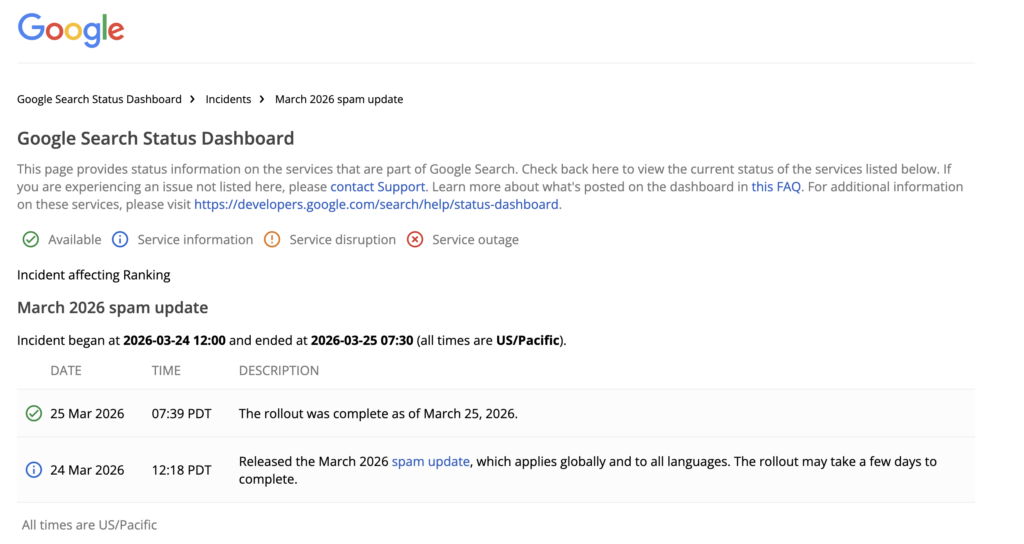
Before diving into the specifics, it’s important to understand what a spam update actually is.
A spam update is designed to improve search quality by targeting websites that violate Google’s spam policies. These updates are not about rewarding great content—they are about removing bad actors from the search ecosystem.
This means if your site is impacted by a spam update, it’s often a signal that something in your SEO strategy may not align with Google’s guidelines.
One of the biggest highlights of this update is Google’s stricter stance on mass-produced AI content.
Let’s be clear—Google is not against AI. However, it strongly discourages the use of AI to generate large volumes of low-quality, repetitive, or unhelpful content.
Websites that relied on:
…have seen significant ranking drops.
👉 What works now?
AI-assisted content that includes human insights, expertise, and originality.
“Parasite SEO” has been a popular tactic where marketers publish content on high-authority domains to rank quickly.
With this update, Google has become better at identifying:
This means simply publishing on a high-domain website is no longer enough—you need context, relevance, and value.
Google has enhanced its spam detection systems to better identify classic black-hat tactics, including:
Websites still relying on outdated SEO tricks are now more likely to be flagged and demoted.
Google continues to double down on its Helpful Content System, emphasizing:
Content that demonstrates real-world knowledge, original insights, and user-first intent is now being rewarded more aggressively.
Many websites experienced significant drops, especially those that relied on shortcuts.
Common characteristics include:
On the flip side, websites focusing on quality saw improvements.
These include:
During the rollout, many websites experienced sudden fluctuations. Some saw traffic drops overnight, while others gained visibility quickly.
This is typical during algorithm updates, but the key difference here is the precision of impact—targeting specific spam signals rather than broad ranking changes.
Publishing 100 blogs per month no longer guarantees success.
Google is now prioritizing:
This marks a major shift in how content strategies should be planned moving forward.
With the rise of AI-driven search experiences, including Google’s AI Overviews, the expectations from content have changed.
Content must now:
If you suspect your site was impacted, look for these signs:
It’s important to compare data before and after the update to identify patterns.
Recovery is possible—but it requires a strategic approach.
Start by reviewing your existing content:
👉 Focus on making your content genuinely useful.
Identify and fix potential issues:
Strengthen your website’s credibility:
Technical health plays a key role in recovery:
Instead of random content, focus on structured strategies:
The March 2026 Spam Update is a clear signal:
👉 SEO is no longer about gaming the system—it’s about serving the user.
Moving forward:
This is also where AI SEO (AEO/GEO) comes into play—optimizing content not just for search engines, but also for AI-driven discovery.
The March 2026 Spam Update is not just another algorithm change—it’s a strong message from Google.
If you’re wondering whether your website was impacted—or what you should fix next—you’re not alone. Most businesses are still trying to figure out how to align with these new changes.
That’s exactly where the right guidance makes all the difference.
At Autus Digital Agency, we work closely with businesses to not just recover from updates—but to build strategies that actually last. From improving content quality to strengthening technical SEO and AI visibility, we focus on what truly moves the needle.
If your rankings dropped, it’s not the end—it’s an opportunity to improve. And if your rankings increased, it’s a sign that your strategy is aligned with where SEO is heading.
If you’re looking for a trusted SEO company in India, Autus Digital Agency can help you understand exactly what’s working—and what’s holding your website back.
We’re offering a free SEO audit of your website, where we’ll:
No jargon. No fluff. Just real insights you can use. Reach out to Autus Digital Agency today and get a clear direction for your SEO growth.

Gaurav is working on various verticals like IT & Software Solutions | Digital Marketing | E-Commerce | BPO | Outsourcing | Offshoring | Global Deliveries | Exports | Education. Gaurav believes in CHANGE, which is constant throughout the LIFE so be with the CHANGE Gaurav is having, In-depth experience in IT Solutions, Offshoring, Internet Branding, Sales & Marketing, Managing New Projects & Processes, Solution Designing and Transitioning of New International and Domestic business engagements. Proficient at managing & leading teams to run successful operations & experienced in developing procedures, service standards, client satisfaction using standard frameworks for business excellence.

Google has officially launched a native integration between Google Business Profile (GBP) and Google Analytics 4 (GA4), letting local businesses track offline and local engagement—like calls, direction requests, and bookings—alongside website and app data in one place. What’s New (and Why It Matters) On June 8, 2026, Google rolled out a direct GBP → GA4 […]
.....
The way the world searches on Google just changed — and not just a little. At Google I/O 2026, the company unveiled what it’s calling the biggest upgrade to the Google Search box in over 25 years, marking a major shift in how users interact with the world’s most popular search engine. For two and […]
.....
Google has rolled out its branded queries filter in Search Console to all eligible sites, simplifying how SEOs analyze branded versus non-branded traffic. This native tool replaces manual regex hacks, making performance reporting more efficient for eCommerce and health sites. Key Takeaways Universal Access: As of March 10, 2026, the AI-powered filter is now live […]
.....
Google released its December 2025 core update on December 11, 2025, and created a buzz in the SEO world. Google released its third big core update this year after March and June. The search landscape could change again. These core updates are surely wide changes to Google’s ranking systems, and effects may take time to […]
.....
Google Search Console’s latest experimental feature is really next-level for marketers, and it has been constantly improving. Now, you can monitor your social media channels in Google Search Console, directly alongside your website. Google has posted this update from its official social media account. It’s a great time-saver and a powerful method for shaping content […]
.....
Google is testing a new mobile search flow in which you can directly switch from AI overview to AI mode without leaving the result page. The information of this test is shared by Robby Stein, who is currently serving as Google’s Vice President of Product for Search. He shared this information on X. Meanwhile, Google […]
.....
SEO has never been static. Even a few years ago, you could get by with basic keyword research and a few backlinks. Now, search engines are smarter, users are savvier, and AI is starting to play a role in determining what content surfaces. For marketers and website owners, keeping up can feel overwhelming. Recently, Semrush […]
.....
If you follow Google’s SEO and structured data updates, 2025 started with big news that surprised even seasoned marketers. Google officially announced the retirement of six types of structured data that have been part of the search ecosystem for years. For webmasters, this is more than a technical change. It signals a shift in how […]
.....
Generative AI (Gen AI) has moved from buzzword to business reality. It is reshaping workflows, strategies, and even results across industries, but in no place is its impact felt more pronounced than in advertising. What was once experimental technology is now being utilized by millions of advertisers across the world, enabling them to design campaigns […]
.....


