


Healthcare marketing has changed rapidly over the last few years. Patients no longer depend only on referrals, offline recommendations, or local directories when searching for doctors. Today, most people search online before booking a medical appointment. They compare clinics, read patient reviews, explore treatment options, and look for trusted healthcare providers near their location.
This major shift in patient behavior has made Google Ads one of the most effective patient acquisition tools for healthcare providers. According to Google Ads and research published by Google Health, healthcare-related searches continue to increase as more users rely on search engines to find nearby doctors, specialists, and treatment centers.
A good Google Ads for doctors SEO outline helps medical practices get more patients who are serious about making an appointment, book more appointments, spend less money on ads, and improve their online presence. Many healthcare businesses use both paid ads and professional SEO services to get more patients and make their websites easier to find in search engines over time.
Without a clear plan, a lot of clinics waste a lot of money on ads that get clicks but don’t turn visitors into actual patients. Putting up ads is not enough for healthcare advertising. Doctors need a detailed plan that focuses on how patients act, what they search for locally, how to get more people to convert, and how to make their campaigns better over time.
For a healthcare advertising campaign to be successful, it needs to have strong keyword targeting, optimized landing pages, local SEO alignment, compelling ad messaging, accurate conversion tracking, and ongoing optimization. Healthcare providers can get more patients and make more money from their ads when these things all work together.
This guide shows healthcare providers how to make a Google Ads plan that will help them get more business, get more online exposure, and build trust with patients over time.
Many medical businesses also improve the results of their campaigns by using both advertising and digital marketing services that are meant to help healthcare brands grow over time.
A Google Ads for doctors SEO outline is a structured framework used to plan, manage, and optimize healthcare advertising campaigns. It combines paid advertising strategies with SEO principles to help healthcare providers appear in front of patients searching for medical services online.
Instead of running random advertisements, this strategy creates a clear roadmap focused on patient acquisition and conversion growth. A well-structured healthcare advertising strategy helps clinics target the right audience, improve campaign efficiency, and increase appointment bookings.
Most successful healthcare campaigns focus heavily on patient search behavior. When patients search online for healthcare services, they are often looking for immediate answers or quick appointment availability. Because of this, healthcare campaigns must focus on highly targeted search intent instead of broad advertising approaches.
Modern healthcare businesses often improve advertising performance through advanced campaign management systems and PPC management services that improve keyword targeting, bidding efficiency, and conversion optimization.
When paid advertising and SEO strategies work together, healthcare providers can build stronger visibility across search results while improving patient trust and long-term brand recognition.
Many healthcare providers launch advertising campaigns without proper planning. This often results in poor conversion rates, high advertising costs, irrelevant traffic, and weak patient engagement.
A structured Google Ads strategy helps healthcare providers avoid these problems by focusing campaigns around patient search intent and conversion-focused optimization.
Healthcare searches often show strong buying intent because users are actively searching for medical help. Searches like “dentist near me,” “orthopedic doctor in Delhi,” “same-day dermatologist appointment,” or “best pediatric clinic nearby” usually come from users ready to book appointments quickly.
When clinics appear in both paid advertisements and organic search results, patient trust often increases significantly. This visibility improves click-through rates, strengthens brand credibility, and increases appointment bookings.
Healthcare providers that invest in both advertising and SEO strategies often achieve stronger long-term visibility compared to businesses relying only on one marketing channel.
Patient intent is one of the most important factors in healthcare advertising success. Most healthcare-related searches happen because users need immediate medical information, treatment support, or appointment availability.
This means healthcare campaigns should focus heavily on attracting users who are ready to take action. Understanding how patients search online helps doctors create more targeted advertising campaigns that attract qualified patients instead of low-quality website traffic.
Many healthcare searches are location-focused because patients usually prefer nearby clinics and healthcare providers. Searches related to emergency treatments, specialist consultations, same-day appointments, or symptom-related healthcare services often generate strong conversion opportunities.
Research published by Think with Google shows that users searching for healthcare services locally often make decisions quickly after finding trusted providers online. This makes search visibility extremely important for healthcare businesses competing in local markets.
Every successful healthcare advertising campaign begins with clear goals. Medical practices should define measurable objectives before investing money into Google Ads campaigns.
Without proper goals, healthcare providers often struggle to measure campaign performance accurately. Clear objectives help clinics track patient acquisition costs, conversion rates, and advertising return on investment.
Healthcare advertising goals often focus on increasing appointment bookings, attracting new patients, improving local search visibility, promoting specialized treatments, and reducing overall lead acquisition costs.
For example, a dental clinic may focus on increasing cosmetic dentistry consultations while reducing advertising costs for general dental services. A dermatology clinic may focus more heavily on promoting high-value skin treatment services or same-day consultation bookings.
Clearly defined goals create stronger campaign direction and improve long-term optimization efforts.
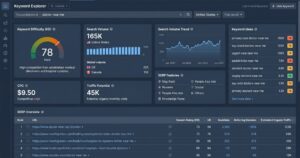
Healthcare keyword research dashboards help doctors target high-intent patient searches.
Keyword research is one of the most important parts of healthcare advertising. Choosing the wrong keywords can waste large advertising budgets, while choosing the right keywords helps clinics attract patients actively searching for healthcare services.
A successful healthcare advertising strategy focuses heavily on high-intent medical keywords. These keywords often generate stronger conversions because users searching these terms are usually ready to contact healthcare providers.
Healthcare providers should focus strongly on local and intent-driven searches. Keywords connected to nearby healthcare services, emergency care, specialist appointments, and treatment-focused searches often perform better than broad medical keywords.
Long-tail keywords also play an important role in healthcare advertising campaigns. Searches like “same-day skin specialist appointment” or “affordable dental implants near me” often generate higher conversion rates because they target very specific patient needs.
Healthcare providers should also use negative keywords to reduce wasted advertising spend. Excluding irrelevant searches related to healthcare jobs, free medical advice, online courses, or unrelated medical services helps improve campaign efficiency.
Many healthcare advertisers also improve keyword targeting through data analysis tools like Google Analytics and advanced analytics optimization services that help identify high-performing search trends and user behavior patterns.
Landing pages play a critical role in healthcare advertising success. Even well-written advertisements can fail if users land on confusing or poorly designed pages.
A strong healthcare landing page should immediately build trust while guiding users toward booking appointments or contacting the clinic.
Healthcare landing pages should clearly explain treatment services, doctor expertise, appointment availability, and patient benefits. Strong headlines, trust-building content, and clear calls to action often improve patient conversions significantly.
Important trust elements may include doctor certifications, years of medical experience, patient testimonials, clinic awards, and treatment success information.
The landing page should also match the advertisement message closely. If an advertisement promotes same-day appointments, the landing page should immediately highlight appointment availability. Consistency between advertisements and landing pages improves both user trust and Google Ads quality scores.
Healthcare businesses that improve technical website performance through technical SEO audits often experience stronger conversion performance and lower bounce rates.
Mobile optimization is also extremely important because most healthcare searches now happen on smartphones. Slow-loading websites, difficult navigation systems, or complicated booking forms often reduce patient conversions quickly.
Ad copy plays a major role in healthcare campaign performance. Strong healthcare advertisements should focus on patient concerns, treatment benefits, and trust-building messaging.
Instead of simply listing healthcare services, advertisements should explain why patients should trust the clinic or doctor.
Strong healthcare advertisements often focus on patient-focused messaging such as experienced medical professionals, same-day appointments, advanced treatment solutions, compassionate care, and trusted healthcare expertise.
Creating urgency in healthcare advertising can also improve conversion rates. Patients searching for healthcare support often want fast solutions, which means appointment-focused messaging can perform very well.
Budget management is extremely important for long-term healthcare advertising success. Healthcare advertising costs often vary depending on specialty competition, clinic location, patient demand, and keyword competition.
Doctors should avoid increasing advertising budgets aggressively without understanding campaign performance data first.
A better approach involves testing campaigns carefully, monitoring conversion performance, analyzing patient acquisition costs, and gradually scaling profitable campaigns over time.
Smart budget planning helps healthcare providers improve advertising return on investment while reducing unnecessary spending.
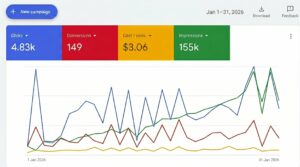
Realistic Google Ads analytics dashboard displaying healthcare campaign metrics including CPC, clicks, impressions, and patient conversion tracking.
Google Ads provides several automated bidding strategies designed to improve campaign performance.
Healthcare providers often use bidding strategies focused on conversion optimization and patient acquisition efficiency.
Popular bidding approaches include:
Choosing the right bidding strategy depends on campaign goals, budget limitations, and historical conversion data.
Without proper conversion tracking, healthcare providers cannot accurately measure campaign performance.
Healthcare businesses should track appointment bookings, phone call inquiries, contact form submissions, and patient consultation requests.
Tracking systems help identify high-performing keywords, strong advertisements, and successful landing pages. This data allows healthcare providers to improve campaigns continuously while reducing wasted advertising spend.
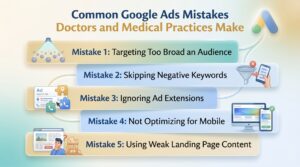
Avoiding common Google Ads mistakes helps doctors improve patient conversions and reduce wasted advertising spend.
Many healthcare advertising campaigns fail because of avoidable mistakes. Broad audience targeting, weak landing pages, poor mobile experiences, and lack of campaign optimization often reduce advertising performance significantly.
Healthcare advertising campaigns require continuous optimization. Doctors should regularly improve keyword targeting, update advertisements, analyze conversion data, and refine landing pages to remain competitive.
One of the strongest healthcare marketing strategies combines SEO with paid advertising campaigns.
SEO improves long-term organic visibility while Google Ads generates faster patient traffic and appointment opportunities.
Together, these strategies improve online visibility, patient trust, appointment bookings, and healthcare brand authority.
Modern healthcare businesses are also preparing for AI-driven search experiences through strategies such as Answer Engine Optimization and voice search optimization.
A well-organized Google Ads for doctors SEO outline helps healthcare professionals get more qualified patients, book more appointments, and get the most out of their advertising dollars.
To be successful in healthcare advertising, you need to do thorough keyword research, make sure your landing pages are optimized, write persuasive ad copy, track conversions accurately, use smart bidding strategies, and keep optimizing.
Healthcare companies that use both SEO and paid advertising strategies often get more exposure, build trust with patients, and grow in a way that lasts in very competitive healthcare markets.
The cost of Google Ads for doctors depends on factors such as medical specialty, location, competition, and keyword demand. Highly competitive specialties like cosmetic surgery, dermatology, and dental services often have higher cost-per-click rates. Many medical practices start with controlled monthly budgets and scale campaigns based on patient conversion performance and return on investment.
Yes, Google Ads can be highly effective for medical practices because they target patients actively searching for healthcare services online. Well-optimized campaigns help clinics increase appointment bookings, attract high-intent patients, improve local visibility, and generate faster patient inquiries compared to relying only on organic traffic.
The best Google Ads strategy for doctors includes high-intent keyword targeting, local SEO alignment, optimized landing pages, strong ad copy, conversion tracking, and continuous campaign optimization. Successful healthcare campaigns focus on attracting qualified local patients while reducing wasted advertising spend.
Doctors can target local patients by using location-based keywords, geographic targeting settings, local extensions, and city-specific ad campaigns. Keywords such as “dentist near me” or “cardiologist in Delhi” help attract nearby patients searching for immediate healthcare services.
Yes, naturopathic doctors can run Google Ads campaigns, but they must follow Google's healthcare and advertising policies carefully. Ads should avoid misleading medical claims and focus on accurate service descriptions, patient education, and compliant healthcare messaging.
While some clinics manage campaigns internally, many healthcare providers work with specialized Google Ads agencies because medical advertising requires experience with healthcare targeting, compliance guidelines, conversion optimization, and patient acquisition strategies. A skilled agency can help improve campaign performance and reduce wasted ad spend.
Doctors should focus on high-intent keywords that match patient search behavior. These may include treatment-specific keywords, specialist searches, emergency healthcare searches, and local intent phrases such as “pediatrician near me,” “skin specialist in Delhi,” or “same-day dentist appointment.”
Google Ads itself can be used by healthcare providers, but doctors must ensure that their advertising practices and patient data handling follow HIPAA compliance requirements. Healthcare campaigns should avoid exposing protected patient information and should use secure landing pages and compliant data tracking systems.

Gaurav is working on various verticals like IT & Software Solutions | Digital Marketing | E-Commerce | BPO | Outsourcing | Offshoring | Global Deliveries | Exports | Education. Gaurav believes in CHANGE, which is constant throughout the LIFE so be with the CHANGE Gaurav is having, In-depth experience in IT Solutions, Offshoring, Internet Branding, Sales & Marketing, Managing New Projects & Processes, Solution Designing and Transitioning of New International and Domestic business engagements. Proficient at managing & leading teams to run successful operations & experienced in developing procedures, service standards, client satisfaction using standard frameworks for business excellence.


SEO has emerged as one of the most dependable digital marketing strategies in the United States. Today’s companies have realized the importance of SEO for their businesses; that is why SEO has received considerable attention from organizations. They prefer SEO services over paid marketing campaigns as it yields sustained success. SEO not only provides sustained […]
.....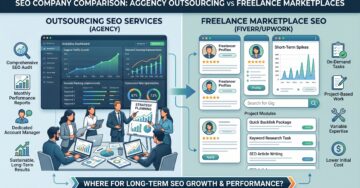
SEO is considered the biggest investment for any company seeking to expand online. Yet, finding the right SEO service to work with can be complicated. Today, many businesses find themselves at the same crossroads. Do you opt for outsourcing SEO services to a specialized company, or do you choose marketplaces such as Fiverr and Upwork? […]
.....
How to Buy Backlinks without Getting Penalized by Google Backlinks continue to be important for search engine rankings. If another website has already been established as reliable, then having its link on your webpage is good for both credibility and relevance. However, getting backlinks is much more complicated than simply purchasing them, because that can […]
.....
The Global Rise of Performance-Driven Digital Marketing Agencies Digital marketing isn’t simply about putting up ads and posting content online anymore in 2026. In order to stay competitive in an economy that is becoming more digital-first, businesses all over the world are putting a lot of money into search engine optimization (SEO), generative engine optimization, […]
.....
Google is constantly tweaking its search interface, and the latest experiment spotted in the wild could signal a shift in how users access its advanced AI features. According to a recent report, Google is testing a new blue “Send” button that appears in the search box as you start typing—replacing the prominent AI Mode button. […]
.....
Amid the constantly changing digital marketing scene, Reddit has undergone a spectacular makeover, more impressive than many. While Reddit has long been regarded as a niche forum for enthusiasts and internet subcultures, it is growing in search-driven visibility. Its tremendous spike in Google search interest is changing the way marketers view customer engagement, SEO strategy, […]
.....
In today’s digital-first era, the way people are searching for information is changing rapidly. While text-based search remains key, voice and visual search are growing in traction, changing the way people engage with brands online. In 2025, if you aren’t optimizing for these emerging search behaviors, you’re losing a crucial opportunity for your brand growth. Voice search optimization, […]
.....
Are you also curious to get in-depth insights into how Google actually ranks content? A set of Google internal documents has leaked which has revealed the elements the search engine giant considers to rank content. On March 27, an automated bot named yashi-code-bot released a 2500-page Google internal document on GitHub. In April, Rand Fishkin, […]
.....
In the past few years, AI has dramatically improved search performance. In May 2023, Google announced its new AI-powered search model, Search Generative Experiences (SGE), which is currently in the beta phase. With SGE, users will get summarized answers from different sources in the SERPs. The complete SGE is supposed to roll out in mid-2024 […]
.....
Did you know Google searchers use its autocomplete suggestions 23% of the time? Let us tell you another interesting fact, too. On average, a user takes nearly 14.6 seconds to click on their search results. SEO has evolved drastically over the last decade, and some major algorithm shifts have occurred. Now, in the 2020s, the […]
.....
Google Search Console is an excellent tool whether you are a digital marketing professional or a business owner. This is a free tool that comes in handy to track the performance of a website, engagement, and areas of improvement. You can also search your website’s ranking and technical errors using this tool. In this comprehensive […]
.....
Are you tirеd of struggling to maintain an effective digital marketing strategy? Do you find yoursеlf overwhelmed by thе ever-changing landscapе and еndlеss tasks that comе with it? If so, it might bе timе to consider thе powеr of a whitе labеl digital marketing agency. In this dynamic and compеtitivе еra, where businesses need to […]
..... In 2023, the online/digital marketing industry is expected to be a $1.2 trillion industry. The competition for consumer attention is ferocious, and online marketers are always trying to find new ways to get their message out there and keep consumers engaged. Digital marketing is a very broad term, and we have seen a lot of […]
.....
Are you looking to position your brand effectively in the digital space? Do you like to make a notable difference in business finances in 2023? How to promote agency activities with the assistance of suitable plans? Digital marketing has changed how marketing plans are prepared in the modern world. As businesses shift to online platforms […]
.....
Certain information is always essential when developing and implementing any market strategy by utilizing campaigns. Everyone is already introduced to the old days when marketing campaigns meant running ads on the radio and placing print ads in the newspaper to spread information about products and services perfectly. Currently, the world has turned to a digital […]
.....
Content, social media marketing, and PPC advertising are primary areas where most new players allocate their digital marketing budgets. That makes sense — they are quick, relatively inexpensive, and can provide that all-important bottom line visibility. So, Does That Mean Is Search Engine Optimization Dead? Never has there been so much data and stats available […]
.....
The world has gone digital, and traditional ways of marketing are slowly fading away. Most people nowadays rely on their smart devices to search for products or services at any given time. The most frequent, trivial question asked on Google was ‘What to watch,’ which was enquired by about 7.5 million people from July to […]
.....
Having an online presence is not just a way to market your company, it is the only way! With more and more consumers embracing technology, you simply cannot afford to neglect digital marketing. There are in fact more benefits of digital marketing that meets the eye and therefore it is time you hopped aboard and […]
.....
Running a successful HVAC business is no easy task. That said, it is certainly one of the best kinds of businesses you can run. Whether the economy is in recession or is booming, HVAC companies remain in business. However, your HVAC business needs to have a strong brand presence to dominate the market and remain […]
.....
An effective lead generation strategy is the backbone of a successful marketing firms Los Angeles. Before we move any further, let’s understand what a lead is. A lead is any person who indicates interest in your products or services. A business contacts a lead after the person performs a desirable activity such as submitting personal […]
.....


