


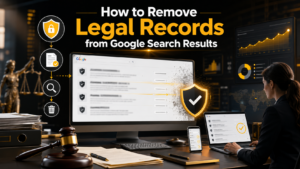
Step-by-step process to remove and manage legal records online
Understanding how to Remove Legal Records from Google Search Results is important for anyone who wants to protect their online reputation and privacy. Legal records such as court cases, arrest records, or public filings can appear in search results and affect personal or professional life. Even if the information is old or no longer relevant, it may still show up when someone searches your name.
Google does not create this content. It only shows links from other websites. This means removing legal records is not always simple. You need to understand where the information is hosted and how it appears in search results. Once you know this, you can take the right steps to remove or hide it.
Many people feel stressed when they see personal legal records online. However, there are legal and safe ways to handle this. With the right process, you can reduce visibility or completely remove certain results. This guide will explain everything step by step in simple language so you can take control of your online presence.
Legal records appear in search results because they are often public information. Courts, government websites, and third-party platforms publish these records online for transparency. Google then indexes these pages and shows them when someone searches related keywords.
When learning how to Remove Legal Records from Google Search Results, it is important to understand that Google does not control the original data. It simply organizes and displays it. This is why removing the record from the source website is usually the most effective solution.
Many websites collect and share legal data. Some are official government portals, while others are private data aggregator sites. These aggregator websites often copy information from public sources and make it easier to find through search engines.
Another reason legal records appear is strong SEO. Many of these sites are optimized to rank high in search results. This means they can stay visible for a long time, even if the information is outdated.
Understanding why these records appear helps you choose the best removal strategy. Instead of guessing, you can focus on the right steps to reduce or eliminate unwanted search results.
Before you learn how to Remove Legal Records from Google Search Results, you should know the types of records that may appear online. Different types require different removal methods.
Common types include court records. These may include civil cases, lawsuits, or judgments. They are often published on official court websites and can remain online for many years.
Another type is arrest records. Even if charges are dropped, these records may still appear on third-party websites. This can affect your reputation, especially if the information is incomplete or misleading.
Bankruptcy records are also common. These are public by law and are often indexed by search engines. They may appear on legal databases or financial websites.
Other records include liens, legal notices, and public filings. These documents are usually shared for legal transparency and may be difficult to remove completely.
Understanding the type of record helps you choose the right approach. Some records can be removed easily, while others may require legal steps or professional help.
Many people ask if it is really possible to remove legal records from search results. The answer is yes, but it depends on the situation. When exploring how to Remove Legal Records from Google Search Results, you need to understand the difference between removing content and removing search results.
If the content is removed from the original website, Google will eventually remove it from search results. This is the best and most effective method. However, if the content remains online, you may still have options to reduce its visibility.
Google offers removal tools for certain cases. For example, if the content includes sensitive personal information, outdated data, or violates privacy rules, you can request removal. However, Google reviews each request carefully and may not approve all cases.
Some records cannot be fully removed due to legal requirements. In such cases, you can focus on suppressing them by improving positive content about you.
So, while complete removal is not always possible, you can still control how much visibility these records get in search results.
Now let’s go through the process step by step. Following these steps carefully will help you achieve better results.
The first step in How to Remove Legal Records from Google Search Results is to find where the information is coming from. Google only shows links, so you need to locate the actual website hosting the record.
Search your name or related keywords and list all the URLs that show the legal record. Visit each link and identify whether it is a government website, court database, or third-party platform.
Understanding the source is important because each type of website has a different removal process. Government sites may have strict rules, while private sites may offer easier removal options.
Make a list of all sources and categorize them. This will help you plan your next steps clearly and avoid confusion later in the process.
Once you identify the source, the next step in How to Remove Legal Records from Google Search Results is to contact the website owner. Removing the content from the original site is the most effective way to remove it from Google.
Look for a contact page or support section on the website. Many sites provide a removal request form. Explain your situation clearly and politely. Provide details such as your name, the URL, and the reason for removal.
Some websites may charge a fee for removal, especially data aggregator sites. Others may remove the content if it is outdated or incorrect.
Keep records of your communication. If the site agrees to remove the content, Google will update its search results automatically after some time.
If the website does not respond or refuses to remove the content, you can use Google’s removal tools. This is an important step in How to Remove Legal Records from Google Search Results when direct removal is not possible.

Use Google tools to request removal and track visibility
Google provides options to request removal of sensitive information. This includes personal data such as ID numbers, financial details, or private records that should not be publicly visible.
You can submit a request through Google’s removal form. Provide accurate details and explain why the content should be removed. Google will review your request and decide whether it meets their guidelines.
This process may take time, but it can help reduce the visibility of unwanted results.
Sometimes, the content is already removed from the website but still appears in search results. This happens because Google stores cached versions of pages.
In this case, you can request removal of outdated content. This is a useful step in How to Remove Legal Records from Google Search Results when the original page no longer exists.
Use Google’s “Remove Outdated Content” tool and submit the URL. Once processed, Google will update its index and remove the outdated result.
This step ensures that old or deleted information does not continue to appear in search results.
In some cases, you may need legal help. This step in How to Remove Legal Records from Google Search Results is important when dealing with false or harmful information.
If the content is incorrect, defamatory, or violates your rights, you can send a legal notice to the website owner. In serious cases, you may need to take legal action to have the content removed.
Consulting a legal expert can help you understand your rights and choose the best approach. While this step may take time, it can be effective in complex situations.
How to Monitor Results After Removing Legal Records from Google

Track rankings, alerts, and search visibility changes
Once you take steps to remove legal records from Google search results, your job is not finished. You must keep checking if the content is really gone or still showing in some way. Google updates its index often, but sometimes removed content may still appear for a while.
Start by searching your name or case details regularly. Use private browsing or incognito mode, so results are not affected by your past searches. This helps you see what others see.
You should also set up alerts using tools like Google Alerts. This tool will notify you if your name or legal record appears again online. It is a simple and free way to stay updated.
Another useful method is checking different versions of Google, such as google.com and google.co.in. Sometimes results vary by region.
Keep a record of the links you have removed. If they appear again, you can quickly take action. Also, revisit the Google removal tool dashboard to track the status of your requests.
Monitoring is important because new websites may copy old legal data. By staying active, you can protect your online image and prevent the issue from coming back.
Sometimes Google may reject your request to remove legal records from Google search results. This can feel frustrating, but it does not mean you have no options.
First, carefully read the reason for rejection. Google usually explains why your request was not accepted. Common reasons include lack of proof, public interest, or missing documents.
If your request was incomplete, you can fix the issue and submit it again. Add clear proof such as court orders, ID documents, or official papers. Make sure all details match the content you want removed.
If Google says the content is in the public interest, you may need to take a different path. In such cases, contacting the website owner directly may be more effective. You can request that they remove or update the information.
Another option is legal help. A lawyer can guide you on how to handle sensitive legal content online. In some cases, a court order can make removal easier.
Do not give up after one rejection. Many people succeed after submitting a stronger request. Stay calm, improve your application, and try again with better details.
The time required to remove legal records from Google search results can vary. It depends on the type of request and how complex the case is.
For basic removal requests using Google tools, it may take a few days to a few weeks. Google reviews each request manually, so timing is not always fixed.
If you contact a website owner, the timeline depends on how quickly they respond. Some websites act fast, while others may take longer or ignore requests.
Legal processes usually take more time. If you need a court order, it may take weeks or even months. But once approved, removal becomes easier and more permanent.
After removal, it may still take time for Google to update search results. This is called “de-indexing delay.” During this time, the link may still appear but will disappear soon.
Be patient and keep checking progress. Each case is different, so timelines are not exact. The key is to stay consistent and follow up when needed.

Strengthen your digital presence with SEO and content strategies
After you successfully remove legal records from Google search results, you should take steps to protect your online image moving forward.
One of the best ways is to create positive content about yourself. This can include social media profiles, blog posts, or professional websites. When people search your name, these positive results will appear first.
Keep your social profiles updated and clean. Avoid sharing sensitive or private details publicly. Think before posting anything online.
You can also use personal branding techniques. For example, create a LinkedIn profile or a portfolio website. These platforms rank well on Google and help build trust.
Another smart step is to regularly search your name online. This helps you find any new issues early. If you notice something wrong, you can act quickly.
Using online reputation management tools can also help. These tools track mentions of your name and alert you when new content appears.
Protecting your online identity is not a one-time task. It is an ongoing process. Stay aware, stay active, and maintain a positive digital presence.
Removing legal records from Google can feel difficult, but it is possible with the right steps. You need to understand where the content exists, choose the correct removal method, and provide proper proof.
The process includes contacting website owners, using Google’s removal tools, and sometimes taking legal action. Each method works differently, so choosing the right one is important.
Yes, in many cases you can remove legal records from Google search results, especially if the content is outdated, incorrect, or violates privacy rules. However, public records may be harder to remove fully.
Yes, it is legal. Google provides official tools for removal requests, and laws like the Right to Be Forgotten support this in some regions.
Not always. You can use Google’s removal tools yourself. But for complex cases, legal help can improve your chances.
Basic removal through Google is free. Costs may apply if you hire a lawyer or use reputation management services.
You can still request Google to remove it from search results. In serious cases, legal action may be needed.
If removed properly, it will not appear in search results. But it may still exist on the original website unless removed there too.

Gaurav Madan, Founder and CEO of Autus Digital Agency, is a pioneering figure in digital marketing with experience of 20+ years. His expertise revolutionizes online marketing strategies and leverages digital platforms for business growth. Gaurav’s consumer-centric approach and strategic vision propel diverse industries to position online presence and dominate.


Search engines have transformed dramatically over the past two decades. Early search engines relied heavily on matching keywords, backlinks, and page authority to determine rankings. Today, artificial intelligence is redefining how information is discovered, interpreted, and delivered. Instead of simply displaying a list of blue links, modern AI-powered search engines analyze user intent, understand context, […]
.....
If you run a local business, showing up at the top of Google Maps can directly impact your visibility, leads, and revenue. When people search for services “near me,” Google prioritizes businesses that are optimized, relevant, and trustworthy. That’s why learning how to rank higher on Google Maps is essential for any business aiming to […]
.....
In today’s competitive social media landscape, simply posting good content is not enough. If your profile is not optimized, your chances of being discovered by new audiences are extremely limited. That’s where Instagram profile optimization comes into play. It acts as the foundation for visibility, discoverability, and long-term growth on the platform. Whether you are […]
.....
An SEO Audit is the process of checking your website to understand how well it performs in search engines like Google. It helps you identify problems, improve weak areas, and build a strong base for better rankings. Many website owners focus only on content or backlinks, but without a proper audit, they miss important issues […]
.....
Google Search Console — never a better SEO tool for website owners and marketers. It enables better insights into how your website is performing, tracks clicks and impressions on search engines for relevant queries, and offers valuable indexing information. In addition to Search Ads 360, Google has now rolled out reporting for social and video […]
.....
Why You Need to Spot Fake Online Reviews The buy-before-buying: where to eat, which service to choose — people make all choices based on online tips. Before spending their money, most people read reviews. Good reviews instil trust in the mind; bad reviews force users not to buy. But not every review is real. Whatever […]
.....
Social media marketing is now more than a platform for sharing! In 2026, this is now the simplest approach to boost YouTube subscribers and have a more active video activity as well as gathering a loyal audience. YouTube’s recommendation system is still the most powerful, but creators who create promotional content for a variety of […]
.....
In 2026, your online reputation is one of the most important digital assets. If you have a company, working freelance, creating the startup you will want to build a personal brand and earlier than that people will be searching online before making decisions. They read reviews, look at your website, visit social networks and consider […]
.....
Online reviews help people make smart buying decisions. Before choosing a product or service, many people read customer reviews. They want honest opinions from real users. However, fake reviews have become more common. Because of this, people now check reviews more carefully. A trustworthy review helps customers feel confident. It also helps businesses build a […]
.....
Google is rolling out new AI Performance Reports in Google Search Console. These reports help website owners see how their content appears in Google’s AI-powered search results. This update is important because search is changing fast. Today, people do not only click on blue links. They also get answers from AI Overviews and AI Mode. […]
.....
Instagram has evolved from a simple photo-sharing platform into one of the most powerful online income sources. With millions of active users engaging with brands, creators, and businesses daily, the platform offers numerous opportunities to generate revenue. Whether you are an influencer, entrepreneur, freelancer, or content creator, learning how to earn money on Instagram can […]
.....
Instagram carousel posts have become one of the most effective content formats for increasing engagement, improving reach, and delivering more value to followers. Whether you are a creator, influencer, marketer, or business owner, carousel posts allow you to share multiple images and videos within a single post. However, many users discover after publishing that the […]
.....
The modern digital advertising ecosystem has evolved significantly, and businesses now rely heavily on data-driven advertising systems like Google Ads to achieve scalable growth. This guide provides a structured, informational breakdown of how to build smarter, performance-oriented campaigns designed to improve ROI, optimize targeting, and maximize conversions across competitive industries. The focus is on practical […]
.....
SEO Companies in the USA Search engine optimization has become one of the most critical digital marketing channels for businesses aiming to grow online visibility and revenue. In the USA, SEO companies play a major role in helping brands improve rankings, attract qualified traffic, and convert visitors into customers. With search algorithms becoming more advanced […]
.....
In 2026, short-form video content has become one of the most powerful drivers of growth on Instagram. It plays a central role in personal branding, business marketing, and influencer development. Today, video views are no longer treated as a simple vanity metric—they are a key indicator of content reach, algorithm performance, and audience interest. Whether […]
.....
Snapchat is one of the most widely used social media platforms for sharing short-form photos, videos, and disappearing content known as “Stories.” Unlike traditional social networks, Snapchat is built around temporary content that automatically disappears after 24 hours. This unique system has made it extremely popular, but it has also created strong user curiosity around […]
.....
Search engine optimization has become one of the most important digital growth channels for modern businesses. Whether it is a startup trying to establish market presence, an eCommerce brand looking to increase product sales, or a service-based company focused on generating qualified leads, SEO plays a major role in improving visibility, credibility, and long-term business […]
.....
Today, lead generation is considered to be one of the crucial factors behind the growth of many companies. The current market environment is highly competitive, and attracting clients becomes increasingly difficult and costly each year. In other words, companies do not only aim to get visits to their websites or likes on their pages. Instead, […]
.....
SEO has evolved into one of the most complex digital growth systems in modern marketing. It is no longer limited to ranking websites on Google through keywords and backlinks. SEO by 2026 includes traditional search engines, AI-generated answer systems, and semantic knowledge networks that understand user intent, not just search queries. This transformation has changed […]
.....
US Client Case Study: 312% Organic Growth with Autus Digital Search engine optimisation (SEO) is no longer a nice-to-have in today’s digital economy; it’s the lifeblood of service-based businesses. The “Yellow Pages” technology is over for agencies that do HVAC, plumbing, and electrical work. The first web page of Google is in which corporations fight […]
.....


