


Step-by-step keyword research strategy for SEO and AI-powered search optimization.
Keyword research is always one of the most crucial aspects of search engine optimization. But with the advent of AI in search, the keyword strategy approach of businesses and marketers has evolved. Search engines don’t care about exact matches of keywords anymore. Today’s algorithms are able to comprehend context, user intent, semantic relationships, and conversational search patterns. This transformation has enhanced the sophistication and intelligence of keyword selection for SEO and AI-driven search.
In today’s world, businesses must optimize for both traditional search engines and AI-powered systems that understand the natural language and user behavior in unique ways. Content that is relevant and topical and has a purpose is likely to do better than content that is keyword-stuffed, whether it’s being searched on Google, voice assistants, AI chat systems, or smart search platforms.
There are plenty of sites that are using keywords that are general in nature without knowing what the competition is, how people search and what they are seeking. Others only consider traffic and not conversion potential. The trick is to find a balance between the relevance of the keywords, the intent behind them, the competition, and the business goals.
This step-by-step guide will help you select the right keywords for SEO and AI search optimization, and create a strategy that will help you achieve long-term organic growth.
Some marketers believe artificial intelligence has reduced the importance of keywords. In reality, keywords are still extremely important, but the way search engines process them has evolved significantly.
Modern search systems analyze:
Instead of matching exact phrases only, AI-driven search engines understand what users actually want.
For example, someone searching:
may all receive similar search results because AI recognizes the same intent behind each query.
This means keyword research must now focus on topics and user intent instead of isolated phrases alone.
The first step in choosing SEO keywords is understanding who your audience is and what they are searching for online.
Many businesses fail because they choose keywords based on assumptions instead of real customer behavior. Effective keyword research begins with identifying:
Think about what your audience wants to achieve.
For example:
Each search reflects a different intent.
Understanding audience intent helps create keyword strategies that attract qualified traffic rather than random visitors.
Before researching individual keywords, create a list of broad topics related to your business or website.
These are called core topics or seed topics.
For example, if you run a digital marketing agency, your topics may include:
These broader topics become the foundation for deeper keyword research.
AI-driven search systems prefer websites that demonstrate topical authority. This means covering related subtopics comprehensively rather than publishing disconnected articles.
Instead of targeting only one keyword, modern SEO strategies focus on building complete topic clusters.
Search intent is one of the most important ranking factors in modern SEO.
Google and AI search systems prioritize content that best satisfies user intent.
There are four primary types of search intent:
Users want information or answers.
Examples:
Users want to reach a specific website or brand.
Examples:
Users are ready to take action or buy.
Examples:
Users are researching before making decisions.
Examples:
Choosing keywords that match the correct intent increases engagement and conversions.
Keyword research tools help marketers discover search terms people actively use online.
These tools provide valuable data such as:
Popular keyword research platforms include:
When analyzing keywords, avoid focusing only on high-volume terms.
High-volume keywords are often:
Instead, focus on keywords with:
Long-tail keywords are longer and more specific search phrases.
Examples:
These keywords usually have:
With the rise of voice search and conversational search, AI-powered search engines tend to prioritize natural language queries.
Long-tail keywords also bring in more qualified traffic as the searches are more targeted.
Instead of targeting:
“SEO tools”
you might target:
“best SEO tools for ecommerce businesses”
The second keyword might have less traffic, but it could have a higher conversion rate.
Competitor analysis is a powerful way to discover keyword opportunities.
Review websites that already rank well in your industry and identify:
This process helps uncover opportunities your competitors may have missed.
However, avoid copying competitor strategies directly.
Instead:
AI search systems reward original, useful, and authoritative content rather than duplicate approaches.
Not every keyword is realistic to target immediately.
Keyword difficulty measures how hard it is to rank for a specific term based on factors such as:
New websites should avoid extremely competitive keywords initially.
Instead, focus on:
As website authority grows, businesses can gradually target broader and more competitive keywords.
Balancing difficulty and opportunity is essential for sustainable SEO growth.
Semantic SEO focuses on related concepts and contextual relevance instead of repeating exact keywords excessively.
Modern AI algorithms understand relationships between:
For example, an article about “SEO tools” should naturally include related terms such as:
This helps search engines understand the overall topic more effectively.
Semantic optimization improves:
Keyword stuffing is no longer effective and may harm rankings.
AI-driven search and voice search have increased the importance of conversational queries.
People now search using natural language phrases such as:
These conversational searches often reflect stronger intent and align better with AI-powered systems.
To optimize for conversational keywords:
This approach improves visibility across voice search, featured snippets, and AI-generated search experiences.
Even the best keywords will not perform well if content quality is poor.
Search engines evaluate:
AI systems increasingly prioritize people-first content that genuinely solves problems.
When creating keyword-focused content:
Good user experience supports stronger rankings and higher engagement.
Keyword research is not a one-time process.
Search behavior changes constantly due to:
Monitor keyword performance regularly using analytics and SEO tools.
Track:
This data helps identify:
SEO strategies should evolve continuously based on performance data.
Many websites struggle because they make avoidable keyword mistakes.
Common errors include:
Avoiding these mistakes improves long-term SEO performance and content quality.
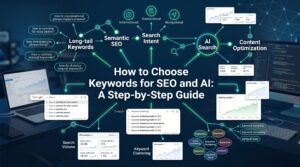
Modern keyword research strategy for SEO and AI-driven search engines.
As artificial intelligence continues transforming search, keyword strategies will become increasingly intent-driven and context-focused.
Future SEO success will rely more on:
Businesses that focus only on exact keyword repetition will struggle to compete.
Instead, successful SEO strategies will combine:
Search engines are moving toward understanding meaning rather than matching isolated phrases.
Choosing the right keywords for SEO and AI is not about picking up the highly trafficked words. Today’s modern strategy to keyword research involves looking at user intent, topical relevance, search patterns and semantic relationships.
The best keyword tactics begin with audience research, competitor analysis, long-tail targeting, semantic optimization, and tracking of performance. The challenge for business is to create content that appeals to both “traditional” search engines and AI-powered search experiences.
Choosing the right keywords can drive targeted traffic to a website, boost its visibility, enhance engagement, and foster sustainable organic growth. With AI driving the evolution of search technology, companies that focus on creating content that is helpful and intent-driven will be best positioned for success.
The world of SEO is not all about ranking pages. In essence, it’s all about understanding your users, addressing their needs, and delivering them a valuable experience – by developing content strategically and optimizing for keywords.
Keyword research is the process of finding and analyzing search terms that people use in search engines. It helps businesses create content that matches user intent and improves visibility in organic search results.
AI-powered search engines understand context, intent, and semantic meaning. Proper keyword research helps businesses optimize content for conversational queries, topical relevance, and AI-driven search experiences.
AI has shifted keyword research from exact-match phrases to intent-based optimization. Modern search systems analyze user behavior, semantic relationships, and conversational language to deliver better search results.
Search intent refers to the reason behind a user’s search query. Common types include informational, navigational, transactional, and commercial intent.

Gaurav Madan, Founder and CEO of Autus Digital Agency, is a pioneering figure in digital marketing with experience of 20+ years. His expertise revolutionizes online marketing strategies and leverages digital platforms for business growth. Gaurav’s consumer-centric approach and strategic vision propel diverse industries to position online presence and dominate.


Social media marketing is now more than a platform for sharing! In 2026, this is now the simplest approach to boost YouTube subscribers and have a more active video activity as well as gathering a loyal audience. YouTube’s recommendation system is still the most powerful, but creators who create promotional content for a variety of […]
.....
In 2026, your online reputation is one of the most important digital assets. If you have a company, working freelance, creating the startup you will want to build a personal brand and earlier than that people will be searching online before making decisions. They read reviews, look at your website, visit social networks and consider […]
.....
Online reviews help people make smart buying decisions. Before choosing a product or service, many people read customer reviews. They want honest opinions from real users. However, fake reviews have become more common. Because of this, people now check reviews more carefully. A trustworthy review helps customers feel confident. It also helps businesses build a […]
.....
Google is rolling out new AI Performance Reports in Google Search Console. These reports help website owners see how their content appears in Google’s AI-powered search results. This update is important because search is changing fast. Today, people do not only click on blue links. They also get answers from AI Overviews and AI Mode. […]
.....
Instagram has evolved from a simple photo-sharing platform into one of the most powerful online income sources. With millions of active users engaging with brands, creators, and businesses daily, the platform offers numerous opportunities to generate revenue. Whether you are an influencer, entrepreneur, freelancer, or content creator, learning how to earn money on Instagram can […]
.....
Instagram carousel posts have become one of the most effective content formats for increasing engagement, improving reach, and delivering more value to followers. Whether you are a creator, influencer, marketer, or business owner, carousel posts allow you to share multiple images and videos within a single post. However, many users discover after publishing that the […]
.....
The modern digital advertising ecosystem has evolved significantly, and businesses now rely heavily on data-driven advertising systems like Google Ads to achieve scalable growth. This guide provides a structured, informational breakdown of how to build smarter, performance-oriented campaigns designed to improve ROI, optimize targeting, and maximize conversions across competitive industries. The focus is on practical […]
.....
Search engine optimization has evolved far beyond rankings and traffic numbers. In 2026, businesses are investing heavily in SEO because organic visibility directly impacts revenue, lead generation, brand authority, and long-term digital growth. However, one question still dominates boardrooms, marketing meetings, and client discussions: How do you actually measure SEO ROI? SEO ROI, or return […]
.....
SEO Companies in the USA Search engine optimization has become one of the most critical digital marketing channels for businesses aiming to grow online visibility and revenue. In the USA, SEO companies play a major role in helping brands improve rankings, attract qualified traffic, and convert visitors into customers. With search algorithms becoming more advanced […]
.....
In 2026, short-form video content has become one of the most powerful drivers of growth on Instagram. It plays a central role in personal branding, business marketing, and influencer development. Today, video views are no longer treated as a simple vanity metric—they are a key indicator of content reach, algorithm performance, and audience interest. Whether […]
.....
Snapchat is one of the most widely used social media platforms for sharing short-form photos, videos, and disappearing content known as “Stories.” Unlike traditional social networks, Snapchat is built around temporary content that automatically disappears after 24 hours. This unique system has made it extremely popular, but it has also created strong user curiosity around […]
.....
Content has become one of the most important factors for digital marketing in the modern era. If organizations want to stay relevant and gain attention from potential customers through the Internet, then they have to develop their blogs, web pages, social media content, emails, and SEO articles to the highest level. Organizations that consistently produce […]
.....
There has been an enormous increase in the demand for SEO services in recent times because companies have realized that search engine rankings play a crucial role in their ability to generate more sales and lead conversions. The growing pressure on digital marketing agencies to offer effective SEO services stems from this realization by various […]
.....
Search engine optimization has become one of the most important digital growth channels for modern businesses. Whether it is a startup trying to establish market presence, an eCommerce brand looking to increase product sales, or a service-based company focused on generating qualified leads, SEO plays a major role in improving visibility, credibility, and long-term business […]
.....
Today, lead generation is considered to be one of the crucial factors behind the growth of many companies. The current market environment is highly competitive, and attracting clients becomes increasingly difficult and costly each year. In other words, companies do not only aim to get visits to their websites or likes on their pages. Instead, […]
.....
SEO has evolved into one of the most complex digital growth systems in modern marketing. It is no longer limited to ranking websites on Google through keywords and backlinks. SEO by 2026 includes traditional search engines, AI-generated answer systems, and semantic knowledge networks that understand user intent, not just search queries. This transformation has changed […]
.....
SEO has rapidly changed. In the past, SEO was about improving rankings on the big search engines using the use of keywords and backlinks, among other elements,s to improve visibility on the Google search engine. But that is no longer the case today. As AI-based search engines such as Google AI Overview and Search Generative […]
.....
US Client Case Study: 312% Organic Growth with Autus Digital Search engine optimisation (SEO) is no longer a nice-to-have in today’s digital economy; it’s the lifeblood of service-based businesses. The “Yellow Pages” technology is over for agencies that do HVAC, plumbing, and electrical work. The first web page of Google is in which corporations fight […]
.....
The way people discover information is changing fast. More users are now asking AI tools questions instead of typing every search into Google, and that shift is changing how brands need to think about visibility. If you want your content to appear in AI answers, you need more than traditional SEO. You need content that […]
.....
In today’s visually driven digital landscape, where images convey information faster than text, Google image search emerges as an indispensable tool. This feature empowers users to query the internet using pictures rather than keywords, revolutionizing how we discover, verify, and leverage visual content. From academic researchers tracing historical artifacts to marketers sourcing high-quality visuals for […]
.....


