


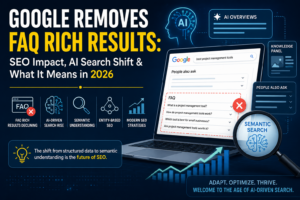
Visual representation of Google reducing FAQ rich results while AI-powered semantic search and entity-based SEO continue to grow.
Google’s handling of FAQ rich results has become one of the most misunderstood developments in modern SEO. Many people describe it as a complete removal, but the reality is more nuanced. FAQ structured data still exists under Schema.org and continues to be supported by Google Search Central, yet its visibility in search results has been drastically reduced.
FAQ schema is no longer a strong SERP enhancement tool, but rather a background-level signal that helps search engines better understand the structure of content, rather than provide enhanced search results. This shift is part of a larger evolution in Google Search, which is shifting from a visual, structured experience to one that is more semantic and driven by AI.
To grasp the true changes, it’s crucial to dissect the development, influence, and present function of FAQ rich results in SEO.
FAQ structured data is a kind of schema mark-up that specifies the question and answer content on a webpage. It was originally designed to assist search engines in understanding the structure of FAQ sections and to possibly show them directly in search results as expandable drop-downs.
In earlier years, websites used FAQ schema to:
In the past, FAQ rich results were a great SEO benefit as they could take up a lot more real estate in search results without needing to build extra links or improve the page’s ranking.
Google documentation originally encouraged proper implementation of FAQ structured data through its official structured data guidelines. Google Structured Data Guidelines
However, over time, Google began limiting how and when these enhancements appear.
For businesses adapting to modern search changes, understanding semantic SEO and content structure has become more important than relying on older schema tactics. This is similar to how companies now focus on advanced SEO execution models like SEO Outsourcing India
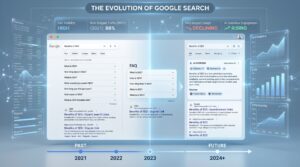
Visual representation of how FAQ rich results have reduced while AI-driven search features increased
The drop in FAQ rich results wasn’t sudden. The transition was a gradual one, with a multi-phase shift that involved changes in search behavior, concerns about content quality, and the emergence of AI-powered search systems.
At first, there were lots of FAQ rich results in most industries. If a website had a well-structured FAQ schema, there was a possibility of it showing expanded FAQs in search results.If a website was structured with a FAQ schema, there was a chance that it would show expanded FAQs in search results. This resulted in the general acceptance by SEO professionals.
However, as usage increased, so did abuse. Many sites started to include too many or too few FAQ sections for the purpose of SEO, not user.Many sites started to include too many or too few FAQ sections for the purpose of SEO, not user. This led to confusing search results and user experiences.
To solve this, Google slowly phased out FAQ enhancements over several stages instead of cutting them off at the knees.
The most crucial thing to understand in this discussion is that FAQ rich results are not completely gone from Google Search. Instead, their visibility has been heavily restricted.
Currently, FAQ rich results are generally limited to:
Even if the schema is implemented correctly, most commercial and content-driven websites no longer appear in search results with FAQ dropdowns. This gives the impression of “removal,” but in reality, the structured data remains and continues to be processed by Google systems.
The major difference today is that FAQ schema doesn’t guarantee any SERP improvement.
Google’s decision to limit FAQ rich results is part of a broader strategy to simplify search results and improve content quality. Several key factors contributed to this shift.
As the years went by, the SERPs grew more complicated. One search might show several different types of features, including featured snippets, knowledge panels, video results, “People Also Ask” boxes, product listings, and FAQ dropdowns.
These features were meant to enhance the user experience, but they had the opposite effect. The search results started to get crowded and pushed organic results further down the page.
Google is trying to make the search experience cleaner and more focused by removing some features, such as FAQ rich results.
FAQ schema was widely adopted as an SEO tactic rather than a user experience improvement. Many websites added large numbers of keyword-rich FAQs that provided little real value to users.
This led to:
By limiting FAQ rich results, Google reduced the incentive for this type of SEO manipulation.
Perhaps the most important reason behind this change is the evolution of search itself. Google is no longer a search engine based on keywords, but an AI-powered information system.
Modern search now uses:
In this context, search engines are no longer relying on structured FAQ displays to comprehend and present information. Rather, they are able to read and understand content directly from pages and dynamically create answers.
Official documentation about AI-driven search experiences can be found on Google AI Overviews Documentation.
As a result, FAQ dropdowns have become less relevant to how information is delivered.
The reduction in FAQ visibility has had several important consequences for SEO strategies and expectations.
Previously, FAQ rich results allowed websites to significantly expand their search listing. A standard result could turn into a large, interactive block occupying more vertical space on the results page.
This had several advantages:
With the removal of this enhancement for most websites, this advantage no longer exists.
One of the most common misconceptions in SEO is that structured data directly improves rankings. FAQ schema does not improve rankings and never functioned as a direct ranking signal.
Today, FAQ structured data:
However, it still provides indirect value by helping search engines better understand page structure and content meaning.
Even though FAQ schema no longer produces visible SERP features in most cases, it still plays a role in content interpretation.
It helps search engines:
This means FAQ schema has transitioned from a visibility tool to a structural understanding tool.

Representation of how SEO is moving from structured data markup to semantic and entity-based understanding
The drop in FAQ rich results is just one of the many shifts in SEO tactics.
In the past, SEO was all about structured data and markup improvements. The aim was to activate certain SERP elements and achieve a visual benefit in the search results.
But today’s SEO is more about understanding and relationships between entities.
In traditional SEO:
In modern SEO:
This shift means that SEO is no longer about “adding markup for visibility” but about creating content that machines can understand contextually.
Yes, FAQ schema still matters, but not in the way it used to.
It is no longer a direct driver of search performance, but it still contributes to content clarity and machine readability.
FAQ schema is useful for:
However, it is not useful for:
It should now be treated as a structural enhancement rather than a growth tactic.

Visual breakdown of modern SEO strategies replacing traditional FAQ optimization
With FAQ rich results no longer playing a major role, SEO strategies have evolved significantly.
Modern search engines focus on entities rather than just keywords. Entities include:
Understanding how these entities relate to each other is now central to ranking and visibility.
Search engines now reward websites that demonstrate deep expertise across entire topics rather than isolated pages.
This involves:
Content must now be optimized for AI extraction systems. This includes:
The goal is to make content easy for machines to interpret and summarize.
FAQ rich results are down but there are still other ways to gain visibility:
Today SEO is about optimizing for these systems and not structured data triggers.
Google hasn’t removed FAQ structured data, but it has certainly made it less relevant for search visibility. The change is part of a larger evolution in search technology, moving from structured markup-driven enhancements to AI-driven semantic understanding.
FAQ schema is no longer a means to get visibility in search results. Instead, it’s a background element that helps search engines to better understand and organize content.
The modern SEO is now about meaning, context and entity relationships, not technical tricks with markup. Those sites that have embraced this change and prioritized topical authority and semantic clarity will continue to do well, while those that are still using old schema strategies will reap less benefits.
No, Google has not completely removed FAQ rich results. Their visibility has been heavily reduced and is now mainly limited to government, healthcare, and highly authoritative websites.
Yes, FAQ schema still works as structured data, but it no longer guarantees enhanced search result visibility for most websites.
No, FAQ schema is not a direct ranking factor. It helps search engines understand page structure better but does not directly improve rankings.
Google reduced FAQ rich results to simplify search pages, reduce spammy SEO practices, improve user experience, and support AI-driven semantic search systems.
Yes, FAQ schema is still useful for improving content structure, machine readability, semantic indexing, and helping AI systems understand question-answer relationships.

Gaurav is working on various verticals like IT & Software Solutions | Digital Marketing | E-Commerce | BPO | Outsourcing | Offshoring | Global Deliveries | Exports | Education. Gaurav believes in CHANGE, which is constant throughout the LIFE so be with the CHANGE Gaurav is having, In-depth experience in IT Solutions, Offshoring, Internet Branding, Sales & Marketing, Managing New Projects & Processes, Solution Designing and Transitioning of New International and Domestic business engagements. Proficient at managing & leading teams to run successful operations & experienced in developing procedures, service standards, client satisfaction using standard frameworks for business excellence.


The pharmaceutical industry has become increasingly digital, with healthcare professionals, patients, and researchers relying on search engines to discover medications, treatment options, clinical research, and healthcare providers. As competition intensifies, pharmaceutical companies need specialized SEO strategies that not only improve search visibility but also comply with strict healthcare regulations. Unlike general SEO agencies, top pharmaceutical […]
.....
Artificial intelligence is transforming how people discover information online. Instead of relying solely on traditional search engines, users increasingly ask questions in platforms such as ChatGPT, Google AI Overviews, Microsoft Copilot, Gemini, Claude, and Perplexity. This shift has introduced new optimization strategies that extend beyond conventional SEO. Among the newest discussions in technical SEO are […]
.....
Why Business Directories Still Matter for Local SEO and Customer Discovery In an era dominated by search engines and social media, many businesses overlook the importance of business directories. However, online directories remain one of the most effective ways to improve local SEO, strengthen online visibility, and help potential customers find products and services. A […]
.....
Local businesses depend on visibility in search results to attract nearby customers. However, even the best-optimized web pages cannot generate traffic if search engines fail to discover and index them quickly. This is where Rapid URL Indexer becomes valuable. It helps website owners, marketers, and SEO professionals accelerate the indexing process, ensuring important pages appear […]
.....
Google Search is growing faster than ever, and one of the biggest changes has been in AI-generated search experiences. Google, instead of showing traditional search results, is just directly giving us AI-generated responses to our queries. AI Overviews: These pointers are changing the way people find things, and how websites enjoy visibility. This represents a […]
.....
Imagine investing months into building a website, publishing content, optimizing pages, and running marketing campaigns—without knowing whether anyone is actually visiting your site. In today’s highly competitive digital landscape, making decisions without traffic data is like navigating unfamiliar roads without a map. Website traffic analysis has become one of the most important aspects of digital […]
.....
Google Expands Publisher Visibility with Search Profiles Google has officially begun rolling out Search Profiles within Google Discover in the United States, introducing a new way for publishers, creators, and brands to establish a stronger presence across Google’s ecosystem. The feature creates dedicated publisher landing pages that allow users to follow content sources, explore recent […]
.....
Why SEO Keyword Research Is the Foundation of Search Success In the modern search landscape, success is no longer about simply inserting keywords into content. It is about understanding what users are searching for, why they are searching for it, and how you can deliver the most relevant and valuable answer at the right moment. […]
.....
: Marketing companies are always under pressure to come up with more effective strategies for their clients, all the while juggling various projects simultaneously. As the expectations of their clients keep rising, most firms find it increasingly challenging to take care of all SEO-related aspects themselves. Increased staffing and costly tools may result in higher […]
.....
The modern digital advertising ecosystem has evolved significantly, and businesses now rely heavily on data-driven advertising systems like Google Ads to achieve scalable growth. This guide provides a structured, informational breakdown of how to build smarter, performance-oriented campaigns designed to improve ROI, optimize targeting, and maximize conversions across competitive industries. The focus is on practical […]
.....
Delhi is one of the most competitive markets in India in terms of doing business. No matter what type of service you offer in your company, whether it’s restaurants, law firms, medical clinics, real estate agencies, educational institutes, or retail stores, people are now turning to the internet for help locating these services. Your company […]
.....
SEO Companies in the USA Search engine optimization has become one of the most critical digital marketing channels for businesses aiming to grow online visibility and revenue. In the USA, SEO companies play a major role in helping brands improve rankings, attract qualified traffic, and convert visitors into customers. With search algorithms becoming more advanced […]
.....
Online presence is one key factor that can determine a business’s success in the modern age. Whether you are selling something or just promoting your brand name, having an effective SEO strategy would help you rank well. With customers checking for information online, SEO is a crucial strategy that should be taken seriously by all […]
.....
Today, SEO is considered the most essential investment in terms of digital marketing by all organizations. Whether it’s a local business, an e-commerce website, a software business, or even an enterprise-level business, having an online presence is necessary to get more visitors. In today’s world, however, SEO does not consist only of stuffing keywords into […]
.....
SEO has evolved into one of the most complex digital growth systems in modern marketing. It is no longer limited to ranking websites on Google through keywords and backlinks. SEO by 2026 includes traditional search engines, AI-generated answer systems, and semantic knowledge networks that understand user intent, not just search queries. This transformation has changed […]
.....
Search engine optimization has changed dramatically over the past few years. Google is using AI to power search results, user intent is more important than exact-match keywords, and competition is growing in almost every niche.Google is using AI to power search results, user intent is more important than exact-match keywords, and competition is growing in […]
.....
SEO is considered to be the most critical element for digital success. SEO is no longer limited to keyword placement and creating backlinks. Contemporary SEO entails technical optimization, content strategy, competition research, and monitoring. Due to these intricate processes, most companies choose to outsource their SEO tasks rather than handle them within their organizations. The […]
.....
When people use Google to search for anything nowadays, they frequently come across an option known as the People Also Ask box. This is where Google provides you with several questions related to your search topic. It is not there by accident because it is part of how people research online and provides significant benefits […]
.....
Your website is built meticulously. You have put in all your service offerings and contact information, and perhaps shared the website URL too. However, if your website not showing up on Google search, it can be frustrating when your company doesn’t appear anywhere. This is a scenario that is very common today in 2026. Thankfully, […]
.....
There is no chance your web pages will appear in search results without being indexed by Google. This implies that you might lose out even though the content you have created is very useful and relevant. Knowing how to submit your URL to Google Search can help you rank better. This procedure is often performed […]
.....


