


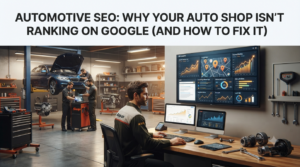
Automotive SEO strategies help auto repair shops improve online visibility and attract more local customers.
If your auto repair shop isn’t showing up when potential customers search for terms like “brake repair near me” or “oil change in my city,” you’re likely missing valuable business every day. Most vehicle owners turn to Google before choosing a mechanic, making your online visibility just as important as the quality of your services. A well-optimized website and local presence can significantly increase phone calls, appointment bookings, and walk-in traffic.
Automotive SEO is the process of improving your website, local listings, and online authority so your business appears higher in search results. Unlike paid ads that stop generating traffic when your budget ends, SEO builds long-term visibility and credibility. This guide explains why many auto shops struggle to rank, highlights the most important ranking factors, and provides practical strategies you can implement to improve your search performance and attract more local customers.
Automotive SEO is the practice of optimizing an automotive business’s website, local listings, and online presence to improve rankings in search engines like Google. The goal is to attract qualified local customers who are actively searching for automotive services.
Automotive SEO combines traditional search engine optimization with local SEO strategies specifically designed for businesses in the automotive industry. Whether you operate an independent repair shop, a dealership, a tire center, or a collision repair facility, SEO helps connect your business with customers who are searching for your services at the exact moment they need them.
Google evaluates hundreds of ranking signals, including content quality, website speed, mobile usability, backlinks, and business reputation. Local factors such as your Google Business Profile, customer reviews, business citations, and location relevance also play a major role in determining rankings.
For example, a repair shop with dedicated service pages for brake repair, engine diagnostics, transmission repair, and suspension services will often outperform a website that lists every service on a single page. Organized content helps search engines understand your expertise while making it easier for potential customers to find the information they need.
Businesses that invest in Automotive SEO typically experience sustainable growth because organic rankings continue driving traffic long after the initial optimization work is completed.
Most auto shops fail to rank because of weak local SEO, poor website optimization, limited content, inconsistent business information, and a lack of authority signals such as quality backlinks and customer reviews.
Many auto repair businesses assume that simply having a website is enough to attract customers. In reality, Google’s ranking algorithm rewards websites that consistently provide value, demonstrate expertise, and deliver an excellent user experience.
One of the most common issues is incomplete keyword optimization. If your homepage only mentions “auto repair” without addressing specific services like AC repair, wheel alignment, or battery replacement, Google has fewer signals to understand what your business offers.
Another major problem is neglecting local SEO. Businesses with inaccurate contact information, inconsistent business listings, or an unoptimized Google Business Profile often struggle to appear in local searches and Google Maps.
Technical issues can also reduce visibility. Slow-loading pages, broken links, poor mobile responsiveness, and missing metadata negatively impact both user experience and search rankings.
Finally, many automotive websites lack fresh, informative content. Publishing helpful articles about vehicle maintenance, seasonal driving tips, and common repair issues demonstrates expertise while increasing opportunities to rank for long-tail search queries.
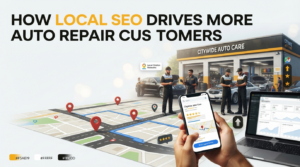
Local SEO improves Google Maps visibility and drives nearby customers to your auto shop.
Local SEO helps automotive businesses appear in location-based searches and Google Maps, making it easier for nearby customers to discover, contact, and visit your shop when they need immediate vehicle repairs.
Local SEO is one of the most valuable marketing investments for automotive businesses because most repair services are location dependent. When someone searches for “mechanic near me” or “oil change nearby,” Google prioritizes businesses with strong local signals.
Your Google Business Profile should include accurate contact details, operating hours, service categories, high-quality photos, and regular updates. Businesses that actively manage their profiles often receive more calls and direction requests than those with outdated information.
Customer reviews are another significant ranking factor. Encouraging satisfied customers to leave detailed reviews not only improves credibility but also signals trustworthiness to Google. Responding professionally to both positive and negative feedback demonstrates strong customer service and online reputation management.
Consistency also matters. Ensure your business name, address, and phone number remain identical across your website, local directories, social platforms, and business listings. Even small inconsistencies can reduce local ranking performance.
Combining local SEO with optimized service pages creates multiple opportunities to appear in both Google’s local pack and traditional organic search results.
On-page Automotive SEO focuses on optimizing individual web pages through high-quality content, strategic keyword placement, metadata, internal linking, and user-friendly page structure to improve rankings and conversions.
Effective on-page SEO starts with understanding how potential customers search for automotive services. Instead of targeting broad keywords alone, create dedicated pages for specific services such as brake repair, engine diagnostics, transmission repair, suspension repair, tire replacement, and preventative maintenance. Each page should address customer questions, explain the service process, highlight benefits, and include a clear call to action.
Optimize title tags, headings, image alt text, and meta descriptions naturally with relevant keywords while avoiding keyword stuffing. Well-structured content using H2 and H3 headings improves readability for both users and search engines.
Internal linking is equally important. Connecting related service pages and educational blog posts helps distribute authority throughout your website while encouraging visitors to explore additional services. Including original photos of your shop, technicians, and completed work also strengthens trust and improves engagement.
Finally, ensure every page loads quickly, displays properly on mobile devices, and provides valuable information that answers customer questions. A positive user experience supports better rankings, longer visit durations, and higher conversion rates.

Technical SEO improves website performance, crawlability, and search visibility for automotive businesses.
Technical SEO ensures your website is fast, secure, mobile-friendly, and easy for search engines to crawl and index. A technically optimized website improves user experience and supports higher rankings for your automotive service pages.
Even the best content won’t perform well if your website has technical issues. Google prioritizes websites that offer a smooth browsing experience, especially on mobile devices where most local automotive searches occur. A slow-loading website can increase bounce rates and reduce conversions, particularly when customers need urgent services like towing or emergency repairs.
Start by testing your website using Google PageSpeed Insights and Google Search Console. Compress images, enable browser caching, minimize unnecessary JavaScript, and use modern image formats like WebP to improve loading times.
Mobile optimization is equally important. Every page should adapt seamlessly to different screen sizes, with readable text, clickable buttons, and fast navigation. Since Google’s indexing is mobile-first, poor mobile usability can directly affect rankings.
Structured data (Schema.org) helps search engines understand your services, reviews, FAQs, business information, and location. Implementing LocalBusiness, Service, FAQ, and Breadcrumb schema can improve search visibility and eligibility for rich results.
Finally, monitor technical issues regularly. Fix broken links, redirect outdated URLs using 301 redirects, maintain a clean XML sitemap, and ensure robots.txt isn’t blocking important pages. A technically healthy website provides a strong foundation for every other SEO effort.
Customer reviews and online reputation directly influence local search rankings and purchasing decisions. A consistent flow of authentic reviews helps establish trust, improve Google Maps visibility, and increase customer inquiries.
Trust is one of the most important factors when customers choose an auto repair shop. Vehicle owners want confidence that their car will be repaired correctly and honestly. Positive online reviews provide that reassurance while also acting as a ranking signal for local SEO.
Encourage satisfied customers to leave reviews immediately after completing a service. The easier you make the process, the more likely customers are to participate. Avoid offering incentives for reviews, as this may violate platform policies.
Respond professionally to both positive and negative feedback. Thank customers for their support and address concerns respectfully. A thoughtful response demonstrates professionalism and customer care, which can positively influence future customers.
Feature customer testimonials throughout your website, especially on service pages. Real experiences help reinforce your expertise and improve conversion rates. Including before-and-after photos, repair case studies, or customer success stories can further strengthen credibility.
A strong reputation extends beyond Google. Consistent business information, active social media marketing, and participation in the local community all contribute to building authority. Businesses with high trust signals are more likely to rank well and convert visitors into loyal customers.
Content marketing helps automotive businesses attract organic traffic by answering customer questions, demonstrating expertise, and targeting long-tail keywords that potential customers search before scheduling vehicle repairs.
High-quality content is one of the most effective ways to improve Automotive SEO. Instead of focusing solely on service pages, create educational articles that solve real customer problems. Informative content helps search engines understand your expertise while attracting visitors who may later become paying customers.
Examples of valuable topics include:
These articles naturally target informational searches while allowing you to internally link to related service pages such as brake repair or engine diagnostics. This strengthens topical authority and improves the user journey.
Keep your content updated as automotive technology evolves. Electric vehicles, hybrid systems, advanced driver assistance systems (ADAS), and connected vehicle technologies are increasingly popular search topics. Covering emerging trends demonstrates industry expertise and helps future-proof your content strategy.
Publishing one or two high-quality articles each month can steadily increase organic traffic and establish your shop as a trusted automotive resource.
Automotive SEO builds sustainable, long-term organic traffic, while paid advertising delivers immediate visibility. Combining both strategies often produces the best marketing results, but SEO typically provides a higher long-term return on investment.
| Feature | Automotive SEO | Paid Advertising (PPC) |
|---|---|---|
| Cost | Long-term investment | Ongoing advertising cost |
| Results | Gradual growth | Immediate traffic |
| Longevity | Continues after optimization | Stops when ads stop |
| Trust | High organic credibility | Marked as sponsored |
| ROI | Excellent over time | Strong for short-term campaigns |
| Best For | Sustainable business growth | Promotions and urgent lead generation |
Many shop owners ask whether they should invest in SEO or Google Ads. The answer depends on business goals, competition, and budget.
SEO requires patience. Most businesses begin seeing meaningful improvements within several months, but those rankings can generate consistent traffic for years with ongoing optimization. Organic visitors also tend to trust search results more than advertisements because they view them as earned rankings.
Paid advertising, on the other hand, produces immediate exposure. It’s particularly useful for promoting seasonal services, special discounts, or launching a new location. However, once the advertising budget is exhausted, traffic typically declines.
The strongest digital marketing strategy combines both approaches. Paid ads generate immediate leads while Automotive SEO builds a sustainable pipeline of future customers. Over time, increased organic visibility can reduce dependence on advertising and lower overall customer acquisition costs.
Measuring Automotive SEO involves tracking rankings, website traffic, phone calls, appointment requests, and customer conversions. Monitoring key performance indicators helps identify what’s working and where improvements are needed.
SEO success isn’t measured solely by rankings. The most important metric is whether your optimization efforts generate qualified customers and business growth.
Use Google Search Console to monitor keyword performance, impressions, click-through rates, and indexing status. Google Analytics 4 helps measure organic traffic, visitor behavior, conversions, and engagement.
For local businesses, monitor metrics within your Google Business Profile, including:
Track conversion-focused metrics such as online appointment requests, contact form submissions, and quote requests. These provide a clearer picture of return on investment than rankings alone.
Review performance monthly and compare results over time. Identify pages with declining traffic, update outdated content, and optimize underperforming service pages. SEO is an ongoing process, and continuous improvements help maintain visibility as search algorithms and customer behavior evolve.
Businesses that consistently analyze their performance data can make informed marketing decisions, improve customer acquisition, and achieve stronger long-term growth through Automotive SEO.
| Mistake | Best Practice |
|---|---|
| Using one page for every service | Create dedicated service pages for each repair type |
| Ignoring Google Business Profile | Keep your profile complete and updated |
| Buying fake reviews | Encourage genuine customer feedback |
| Publishing thin content | Create comprehensive, helpful articles |
| Slow website speed | Optimize Core Web Vitals and page performance |
| Ignoring mobile users | Use responsive, mobile-friendly design |
| Inconsistent business information | Maintain identical Name, Address, and Phone (NAP) across all listings |
| No internal linking | Link related services and blog content naturally |
Automotive SEO is no longer optional for repair shops that want to compete in today’s digital marketplace. When customers search for services like brake repair, oil changes, or engine diagnostics, they typically choose businesses that appear at the top of Google Search and Google Maps. If your website isn’t visible, you’re losing potential customers to competitors with stronger online optimization.
A successful Automotive SEO strategy combines technical SEO, high-quality service pages, local SEO, reputation management, and valuable content marketing. These elements work together to improve search rankings, increase website traffic, and generate more appointment requests.
SEO is an ongoing investment rather than a one-time project. Regularly update your website, monitor performance using Google Analytics 4 and Google Search Console, collect authentic customer reviews, and continue publishing helpful automotive content. By consistently improving your online presence, your auto shop can build long-term authority, attract more qualified leads, and achieve sustainable business growth. Ready to get started? Contact us or explore our SEO packages to see how we can help.
Automotive SEO is the process of optimizing an automotive business's website, Google Business Profile, and online presence to improve visibility in search engines. It helps repair shops, dealerships, and other automotive businesses attract local customers searching for services like brake repair, oil changes, diagnostics, and tire replacement. A strong SEO strategy increases organic traffic, phone calls, and appointment bookings.
Most automotive businesses begin seeing measurable improvements within three to six months, depending on competition, website quality, and existing authority. Highly competitive markets may require additional time. SEO delivers gradual but sustainable growth, making it a valuable long-term marketing investment compared to strategies that stop producing results when advertising budgets end.
Most automotive customers search for services near their location. Local SEO improves visibility in Google Maps and local search results, making it easier for nearby customers to find your business. Optimizing your Google Business Profile, maintaining accurate business information, and collecting customer reviews significantly improve local search performance.
Yes. Effective Automotive SEO attracts visitors who are actively searching for repair services, making them more likely to schedule appointments. Optimized service pages, clear calls to action, fast-loading websites, and strong local visibility all contribute to higher conversion rates and increased customer inquiries.
Absolutely. A Google Business Profile is one of the most important ranking factors for local businesses. It displays your business information, reviews, photos, operating hours, and location in Google Search and Maps. Keeping your profile complete and regularly updated improves both visibility and customer trust.
Automotive businesses should publish service pages, maintenance guides, troubleshooting articles, seasonal driving tips, repair explanations, and frequently asked questions. Helpful content demonstrates expertise, targets long-tail keywords, and supports higher search rankings while educating potential customers before they book a service.



Finding trending topics is one of the most effective ways to create content that attracts readers, ranks higher in search engines, and gains visibility across AI-powered platforms. Whether you’re a blogger, SEO professional, marketer, or business owner, understanding what people are searching for helps you publish content at the right time and stay ahead of […]
.....
Businesses have spent years optimizing websites for Google Search, but AI-powered search experiences are changing how people discover brands. Millions of users now ask ChatGPT, Microsoft Copilot, Gemini, Claude, and Perplexity for recommendations instead of browsing search results. These AI assistants summarize information from trusted sources, making it essential to understand whether your business is […]
.....
Search has entered a new era. Instead of presenting users with a list of web pages, AI-powered search engines now provide direct, conversational answers. Platforms such as Google AI Overviews, ChatGPT, Gemini, Microsoft Copilot, Claude, and Perplexity are changing how people discover information online. As a result, businesses can no longer rely solely on traditional […]
.....
Search behavior has changed dramatically over the last few years. Instead of relying only on traditional search engines, users now seek authentic discussions, real-world experiences, and community-driven recommendations before making decisions. This shift has transformed Reddit from a discussion platform into one of the most influential sources for search visibility. Today, Google frequently ranks Reddit […]
.....
Many advertisers celebrate when their PPC dashboard shows thousands of clicks. Unfortunately, clicks alone don’t generate revenue. If your PPC Campaign Generates Clicks but produces few or no leads, you’re paying for traffic that isn’t converting. This situation is more common than many businesses realize. A campaign may have an excellent Click-Through Rate (CTR), low […]
.....
Search engines have transformed dramatically over the past two decades. Early search engines relied heavily on matching keywords, backlinks, and page authority to determine rankings. Today, artificial intelligence is redefining how information is discovered, interpreted, and delivered. Instead of simply displaying a list of blue links, modern AI-powered search engines analyze user intent, understand context, […]
.....
How to Sell on Amazon: The Complete Guide (2026) Selling on Amazon is among the top approaches known today to start up an online business. Amazon has millions of buyers visiting every single day looking for products in all kinds; you can sell anything on Amazon. This provides new sellers a wonderful opportunity to continue […]
.....
Google Search Console — never a better SEO tool for website owners and marketers. It enables better insights into how your website is performing, tracks clicks and impressions on search engines for relevant queries, and offers valuable indexing information. In addition to Search Ads 360, Google has now rolled out reporting for social and video […]
.....
Google Lighthouse has long been one of the most trusted tools for developers, SEO professionals, and website owners because it evaluates website performance, accessibility, SEO, and overall quality. In 2026, Google introduced a new Lighthouse category called Agentic Browsing, reflecting the growing role of artificial intelligence in web interactions. Unlike traditional search crawlers that mainly […]
.....
Why You Need to Spot Fake Online Reviews The buy-before-buying: where to eat, which service to choose — people make all choices based on online tips. Before spending their money, most people read reviews. Good reviews instil trust in the mind; bad reviews force users not to buy. But not every review is real. Whatever […]
.....
Google reviews are one of the most important parts of local SEO. They help businesses build trust, improve local rankings, and attract new customers. Recently, many business owners noticed that some Google reviews suddenly disappeared. This created confusion and concern, especially for local businesses that depend on customer feedback. In most cases, Google is not […]
.....
The impact of your online reputation and perception on you/your business cannot be understated. Unwanted search results on Google can affect the trust of an individual, a professional body or company and can even lose business opportunities. Whether its news post or bad review, even an irrelevant page, removal or suppression of harmful search results […]
.....
In 2026, your online reputation is one of the most important digital assets. If you have a company, working freelance, creating the startup you will want to build a personal brand and earlier than that people will be searching online before making decisions. They read reviews, look at your website, visit social networks and consider […]
.....
Selling products online has become one of the best ways to build a business. Among all eCommerce platforms, Amazon stands out because millions of customers visit it every day. Whether you want to sell handmade items, private-label products, or branded goods, opening an Amazon store can help you reach a massive audience. The good news […]
.....
The internet continues to shape how Americans communicate, shop, learn, and consume content. Every year, website traffic trends reveal valuable insights into changing user behavior, digital preferences, and emerging technologies. In 2026, the landscape of the Most Visited Websites in the United States reflects the growing influence of search engines, social media platforms, AI-powered tools, […]
.....


