


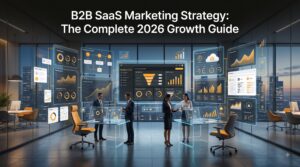
Modern visualization of a complete B2B SaaS marketing ecosystem.
Creating a successful B2B SaaS marketing strategy has become more challenging than ever. With increasing competition, longer buying cycles, AI-powered search experiences, and evolving customer expectations, SaaS companies need far more than a great product to achieve sustainable growth. A modern strategy combines SEO, content marketing, product-led growth, demand generation, paid advertising, marketing automation, customer success, and data-driven decision-making into one cohesive framework.
Unlike traditional businesses, SaaS companies rely on recurring revenue, making customer acquisition and long-term retention equally important. Every stage of the buyer journey—from awareness and evaluation to onboarding and expansion—requires targeted marketing efforts backed by measurable performance metrics.
This guide explains how to develop an effective B2B SaaS marketing strategy for 2026. You’ll learn the essential marketing channels, proven frameworks, growth tactics, and optimization techniques that help attract qualified leads, convert them into loyal customers, and maximize customer lifetime value.
A B2B SaaS marketing strategy is a structured plan that helps software companies attract, convert, retain, and expand business customers using digital marketing channels such as SEO, content marketing, email campaigns, paid advertising, product-led growth, and customer success initiatives.
Unlike one-time product sales, SaaS businesses depend on recurring subscriptions. This means marketing must continuously generate qualified leads while also supporting customer success and retention.
An effective B2B SaaS marketing strategy begins by understanding the target audience. Marketing teams develop detailed buyer personas, identify customer pain points, and map content to every stage of the buyer journey.
The strategy typically includes organic SEO, educational content, webinars, case studies, email nurturing, social media, paid campaigns, product demos, and marketing automation. Teams also monitor customer behavior to improve onboarding, increase product adoption, and reduce churn.
Modern SaaS marketing integrates sales, customer success, and product teams to create a seamless customer experience. Rather than focusing solely on lead generation, successful companies optimize every interaction to maximize customer lifetime value.
A well-planned B2B SaaS marketing strategy helps businesses generate predictable revenue, lower customer acquisition costs, improve lead quality, increase customer retention, and create sustainable long-term growth.
Many SaaS companies invest heavily in product development but struggle with customer acquisition because they lack a comprehensive marketing strategy. Without a clear roadmap, businesses often overspend on advertising, target the wrong audience, or fail to nurture prospects effectively.
A strong strategy aligns marketing objectives with business goals. SEO and content marketing attract organic traffic, while email automation nurtures prospects until they are ready to buy. Paid advertising accelerates growth, and customer success programs improve retention and encourage upselling.
Since acquiring a new customer is generally more expensive than retaining an existing one, successful SaaS companies prioritize customer education, personalized onboarding, and ongoing engagement. This balanced approach improves customer satisfaction while maximizing recurring revenue.
Organizations that continuously measure campaign performance and optimize marketing efforts based on real-time data typically outperform competitors that rely on guesswork.

The essential building blocks of an effective SaaS marketing strategy.
A successful B2B SaaS marketing strategy combines audience research, positioning, SEO, content marketing, paid advertising, automation, analytics, customer success, and continuous optimization to drive predictable business growth.
Every successful SaaS marketing strategy starts with understanding the ideal customer profile (ICP). Businesses must identify industries, company sizes, job roles, purchasing behavior, and common challenges before creating marketing campaigns.
A compelling value proposition differentiates the software from competitors by clearly communicating measurable business outcomes instead of simply listing product features.
SEO builds long-term visibility by targeting high-intent keywords, while educational content such as blogs, whitepapers, webinars, and case studies establishes authority. Paid search and LinkedIn advertising complement organic efforts by reaching decision-makers quickly.
Marketing automation platforms streamline lead nurturing through personalized email workflows, behavior-based segmentation, and lead scoring. CRM integration enables sales teams to prioritize qualified opportunities efficiently.
Continuous performance analysis is equally important. Tracking metrics such as conversion rates, CAC, customer lifetime value, MQL-to-SQL conversion, and churn helps businesses refine campaigns and allocate budgets more effectively.
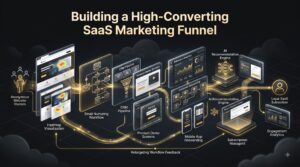
Visualizing the complete SaaS customer acquisition funnel.
A SaaS marketing funnel guides prospects from initial awareness to long-term customer loyalty using targeted content, personalized communication, product experiences, and ongoing customer engagement.
The SaaS buying journey involves multiple touchpoints before a purchase decision is made. At the awareness stage, prospects discover your brand through SEO, educational content, social media, webinars, podcasts, or paid advertising.
During the consideration phase, buyers compare different software solutions. Product comparison pages, customer testimonials, interactive demos, ROI calculators, and detailed case studies help establish trust.
The decision stage focuses on free trials, live demos, consultations, and personalized sales interactions. Reducing friction during signup and providing immediate value significantly improves conversion rates.
However, the funnel doesn’t end after purchase. Effective onboarding ensures customers quickly experience product benefits, while educational resources, proactive support, and feature adoption campaigns encourage long-term engagement.
Customer advocacy programs, referral incentives, upselling opportunities, and regular communication transform satisfied users into loyal brand advocates who contribute to sustainable recurring revenue.

Advanced SEO workflow for sustainable SaaS growth.
SEO is one of the highest ROI channels in a B2B SaaS marketing strategy because it attracts decision-makers actively searching for software solutions. A well-executed SEO strategy generates qualified traffic, lowers customer acquisition costs, and delivers consistent long-term growth.
Organic search is often the foundation of sustainable SaaS growth. Unlike paid campaigns that stop generating traffic when budgets are paused, SEO continues delivering qualified visitors over time.
Start with keyword research focused on every stage of the buyer journey. Informational keywords such as “What is CRM software?” attract awareness, while commercial keywords like “Best CRM software for startups” target users ready to evaluate solutions.
Publishing pillar pages, comparison articles, feature guides, customer success stories, and industry reports helps establish topical authority. Technical SEO—including fast page speed, mobile responsiveness, schema markup, optimized Core Web Vitals, and proper site architecture—improves search visibility.
Regularly updating content, earning authoritative backlinks, and optimizing for AI search engines further strengthen rankings. Combined with conversion-focused landing pages, SEO becomes a powerful engine for predictable lead generation.
Content marketing educates prospects, builds trust, and guides buyers throughout the sales journey. In a B2B SaaS marketing strategy, valuable content positions your company as an industry expert while generating qualified leads.
Today’s SaaS buyers conduct extensive research before speaking with sales representatives. High-quality content answers questions, demonstrates expertise, and reduces purchase uncertainty.
A successful content strategy includes blog articles, whitepapers, case studies, comparison pages, eBooks, webinars, templates, podcasts, product tutorials, and interactive tools.
Content should address each stage of the marketing funnel. Awareness content introduces problems and trends, consideration content compares solutions, and decision-stage content showcases ROI, customer success stories, and implementation guides.
Repurposing content across multiple formats increases reach while reducing production costs. For example, one webinar can become a blog series, social media posts, email campaigns, infographics, and YouTube videos.
Consistency is critical. Companies that regularly publish valuable content often experience stronger organic visibility, improved lead quality, and higher customer trust than competitors relying solely on advertising.
Paid advertising accelerates customer acquisition by reaching high-intent buyers quickly. When integrated into a B2B SaaS marketing strategy, demand generation campaigns complement organic marketing efforts and produce measurable business growth.
Paid advertising enables SaaS companies to reach business decision-makers through search engines, social media, and display networks.
Google Search Ads capture users actively looking for software, while LinkedIn Ads target professionals based on job title, company size, industry, and seniority. Retargeting campaigns reconnect with website visitors who did not convert during their first visit.
Demand generation extends beyond lead collection. Modern campaigns focus on educating buyers through webinars, downloadable resources, industry reports, and free tools before asking for a purchase.
Successful marketers continuously optimize campaigns by testing headlines, landing pages, CTAs, audience segments, and bidding strategies. Monitoring metrics such as Cost per Lead (CPL), Customer Acquisition Cost (CAC), Click-Through Rate (CTR), and Return on Ad Spend (ROAS) helps maximize profitability.
Organic and paid marketing work best together, creating a balanced acquisition strategy.
Account-Based Marketing (ABM) focuses marketing and sales efforts on high-value target accounts instead of broad audiences, making it an effective strategy for enterprise-focused SaaS companies.
Enterprise SaaS purchases often involve multiple stakeholders, including executives, IT teams, procurement departments, and end users. ABM addresses this complexity by creating personalized campaigns for specific organizations.
Instead of generating thousands of generic leads, marketing teams identify strategic accounts that closely match the ideal customer profile. Personalized email sequences, executive webinars, custom landing pages, industry-specific case studies, and tailored product demonstrations increase engagement.
Sales and marketing collaborate closely to nurture decision-makers throughout lengthy buying cycles. This alignment reduces wasted marketing spend while increasing average contract value.
Although ABM requires greater planning and personalization, it often delivers stronger ROI for enterprise SaaS businesses because resources are concentrated on accounts with the highest revenue potential.
Product-Led Growth relies on the product itself to drive customer acquisition, while Sales-Led Growth depends on direct sales interactions. Many successful SaaS companies combine both approaches for maximum growth.
Product-Led Growth allows users to experience value before making a purchasing decision. Free trials, freemium plans, interactive onboarding, and in-app guidance encourage users to adopt the product independently.
This model works particularly well for software with simple implementation and broad market appeal.
Sales-Led Growth, on the other hand, involves demonstrations, consultations, customized pricing, and relationship building. Enterprise software with larger contracts often requires direct sales engagement due to complex purchasing processes.
Many leading SaaS companies adopt a hybrid approach. Smaller businesses can self-serve through free trials, while enterprise prospects receive personalized assistance from experienced sales teams.
Choosing the right model depends on product complexity, pricing, target audience, and average contract value.
Customer retention is essential for SaaS profitability because recurring revenue depends on long-term customer relationships. A strong retention strategy reduces churn while increasing customer lifetime value.
Winning new customers is only half the challenge. Long-term success depends on keeping existing customers satisfied and engaged.
A structured onboarding process helps users quickly achieve meaningful results. Interactive tutorials, onboarding emails, live training sessions, and dedicated customer success teams reduce confusion and improve adoption.
Monitoring product usage enables businesses to identify at-risk customers before they cancel. Automated reminders, feature recommendations, and personalized support improve customer engagement.
Expansion strategies include upselling premium features, cross-selling complementary products, and offering annual subscription discounts. Referral programs also encourage satisfied customers to promote the product within their professional networks.
Businesses with strong retention programs typically experience higher recurring revenue, lower acquisition costs, and improved profitability.
Tracking the right Key Performance Indicators (KPIs) helps SaaS businesses evaluate marketing performance, optimize campaigns, and make data-driven decisions. The most valuable metrics measure customer acquisition, engagement, retention, and recurring revenue.
Every successful B2B SaaS marketing strategy relies on measurable performance metrics. Rather than focusing only on website traffic, businesses should analyze KPIs that directly impact revenue via analytics reporting.
Customer Acquisition Cost (CAC) measures how much it costs to acquire a paying customer. Keeping CAC under control while increasing lead quality improves overall profitability.
Monthly Recurring Revenue (MRR) and Annual Recurring Revenue (ARR) provide insight into predictable income streams and business growth.
Customer Lifetime Value (CLV) estimates the total revenue generated by a customer throughout their relationship with your business. Ideally, CLV should significantly exceed CAC.
Additional KPIs include trial-to-paid conversion rate, demo bookings, marketing-qualified leads (MQLs), sales-qualified leads (SQLs), churn rate, feature adoption, and Net Revenue Retention (NRR). Monitoring these metrics regularly enables marketing teams to identify bottlenecks, improve campaigns, and forecast future growth with greater confidence.
Many SaaS companies struggle because they prioritize traffic over qualified leads, overlook customer retention, or fail to align marketing with sales. Avoiding these common mistakes improves marketing efficiency and long-term growth.
Even excellent SaaS products can fail without a well-executed marketing strategy. One of the most common mistakes is targeting a broad audience instead of focusing on a clearly defined Ideal Customer Profile (ICP). Generic messaging rarely resonates with decision-makers.
Another mistake is treating SEO as a one-time project. Search optimization requires ongoing keyword research, content updates, technical improvements, and authority building.
Many businesses also neglect onboarding after a customer signs up. Without proper guidance, users may never experience the product’s full value, leading to higher churn.
Poor communication between marketing and sales creates inconsistent messaging and lower conversion rates. Both teams should share common goals, lead qualification standards, and performance metrics.
Finally, failing to analyze marketing performance results in wasted budgets. Regular reporting, A/B testing, and campaign optimization help maximize return on investment.
Scaling a B2B SaaS marketing strategy requires automation, continuous optimization, customer-centric messaging, and investment in channels that consistently deliver qualified leads and recurring revenue.
As SaaS companies grow, marketing becomes increasingly complex. Scaling successfully requires standardized processes supported by marketing automation platforms and CRM systems.
Develop comprehensive topic clusters around your core solutions instead of publishing isolated blog posts. This strengthens topical authority and improves search visibility.
Use behavioral segmentation to personalize email campaigns, product recommendations, and customer communication. Personalized experiences typically generate higher engagement and conversion rates.
Experiment continuously with landing pages, pricing pages, CTAs, and onboarding experiences using A/B testing. Small improvements often compound into significant revenue gains over time.
Customer feedback should guide both marketing and product development. Surveys, interviews, and support conversations reveal valuable insights that help refine messaging and prioritize new features.
Finally, balance acquisition with customer success. Sustainable SaaS growth depends on retaining existing customers while continuously attracting new ones.
| Marketing Channel | Primary Goal | Best For | Long-Term ROI |
|---|---|---|---|
| SEO | Organic Traffic | Sustainable Growth | Very High |
| Content Marketing | Education & Authority | Lead Generation | Very High |
| Email Marketing | Lead Nurturing | Customer Retention | High |
| PPC Advertising | Immediate Leads | Fast Growth | Medium-High |
| LinkedIn Ads | B2B Decision Makers | Enterprise SaaS | High |
| Product-Led Growth | User Adoption | Self-Service SaaS | High |
| Account-Based Marketing | Enterprise Accounts | High-Value Clients | Very High |
| Customer Success | Retention | Subscription Growth | Extremely High |
An effective B2B SaaS marketing strategy is much more than a collection of marketing tactics—it is a structured growth system designed to attract the right audience, convert prospects into customers, and maximize recurring revenue. As competition increases and buyers become more informed, SaaS companies must combine SEO, content marketing, demand generation, automation, product-led experiences, and customer success into a unified strategy.
Success depends on understanding your target market, creating valuable content, optimizing every stage of the marketing funnel, and making decisions based on reliable performance data. Businesses that continuously improve their customer experience, invest in long-term organic growth, and measure meaningful KPIs are better positioned to achieve sustainable growth.
By implementing the strategies outlined in this guide, your organization can build a scalable marketing engine that generates qualified leads, strengthens customer relationships, reduces churn, and drives predictable revenue growth in 2026 and beyond. If you’d like expert support executing this strategy, get in touch with our team.
A B2B SaaS marketing strategy is a structured plan that helps software companies attract, convert, retain, and expand business customers through channels such as SEO, content marketing, email campaigns, paid advertising, product-led growth, and customer success. The goal is to increase recurring revenue while reducing customer acquisition costs and improving long-term customer relationships.
SEO helps SaaS businesses attract qualified prospects who are actively searching for software solutions. Unlike paid advertising, SEO generates sustainable organic traffic, improves brand authority, supports content marketing, and reduces long-term acquisition costs while increasing visibility in traditional and AI-powered search engines.
The most effective channels include SEO, content marketing, email marketing, LinkedIn advertising, Google Ads, webinars, referral programs, product-led growth initiatives, and account-based marketing. The best mix depends on your target audience, pricing model, sales cycle, and business goals.
Businesses can reduce acquisition costs by improving SEO, creating high-quality educational content, optimizing conversion rates, automating lead nurturing, refining audience targeting, increasing referral marketing, and continuously analyzing campaign performance to eliminate ineffective marketing spend.
Product-Led Growth is a business model where the software itself drives customer acquisition through free trials, freemium plans, interactive onboarding, and in-product experiences. Users experience value before making a purchasing decision, improving adoption and conversion rates.
Important KPIs include Monthly Recurring Revenue (MRR), Annual Recurring Revenue (ARR), Customer Acquisition Cost (CAC), Customer Lifetime Value (CLV), churn rate, trial-to-paid conversion rate, lead conversion rates, Net Revenue Retention (NRR), and Return on Marketing Investment (ROMI).
Account-Based Marketing focuses resources on high-value target accounts through personalized campaigns. This approach improves engagement, shortens enterprise sales cycles, increases average contract value, and aligns marketing with sales efforts to improve overall ROI.
A SaaS marketing strategy should be reviewed quarterly and refined continuously based on market trends, customer feedback, competitor activity, product updates, and performance metrics. Regular optimization ensures marketing efforts remain effective in a rapidly changing digital landscape.



SEO is one of the most effective long-term digital marketing strategies, but it rarely delivers overnight success. Many website owners become frustrated because they expect immediate improvements after publishing optimized content or fixing technical issues. In reality, successful SEO is measured through gradual improvements across multiple performance indicators rather than a single metric. So, how […]
.....
Duplicate content is one of the most common technical SEO problems affecting websites of all sizes. It occurs when identical or highly similar content appears on multiple URLs, making it difficult for search engines to determine which version should rank in search results. While Google generally doesn’t apply a direct penalty for duplicate content, it […]
.....
A sudden decline in Google traffic can be one of the most stressful situations for any website owner. A website that previously generated consistent visitors, leads, and revenue may suddenly experience fewer clicks, lower rankings, and declining visibility in search results. However, a traffic drop does not always mean a website is permanently damaged. With […]
.....
Artificial intelligence has fundamentally changed how people discover information online. Instead of clicking through multiple search results, users increasingly rely on AI-powered assistants like ChatGPT, Google AI Overviews, Gemini, Claude, Microsoft Copilot, and Perplexity to summarize answers instantly. This shift has introduced a new phenomenon known as Ghost Citations. Your research, statistics, definitions, or insights […]
.....
The pharmaceutical industry has become increasingly digital, with healthcare professionals, patients, and researchers relying on search engines to discover medications, treatment options, clinical research, and healthcare providers. As competition intensifies, pharmaceutical companies need specialized SEO strategies that not only improve search visibility but also comply with strict healthcare regulations. Unlike general SEO agencies, top pharmaceutical […]
.....
If your auto repair shop isn’t showing up when potential customers search for terms like “brake repair near me” or “oil change in my city,” you’re likely missing valuable business every day. Most vehicle owners turn to Google before choosing a mechanic, making your online visibility just as important as the quality of your services. […]
.....
Finding trending topics is one of the most effective ways to create content that attracts readers, ranks higher in search engines, and gains visibility across AI-powered platforms. Whether you’re a blogger, SEO professional, marketer, or business owner, understanding what people are searching for helps you publish content at the right time and stay ahead of […]
.....
Businesses have spent years optimizing websites for Google Search, but AI-powered search experiences are changing how people discover brands. Millions of users now ask ChatGPT, Microsoft Copilot, Gemini, Claude, and Perplexity for recommendations instead of browsing search results. These AI assistants summarize information from trusted sources, making it essential to understand whether your business is […]
.....
Search has entered a new era. Instead of presenting users with a list of web pages, AI-powered search engines now provide direct, conversational answers. Platforms such as Google AI Overviews, ChatGPT, Gemini, Microsoft Copilot, Claude, and Perplexity are changing how people discover information online. As a result, businesses can no longer rely solely on traditional […]
.....
Search behavior has changed dramatically over the last few years. Instead of relying only on traditional search engines, users now seek authentic discussions, real-world experiences, and community-driven recommendations before making decisions. This shift has transformed Reddit from a discussion platform into one of the most influential sources for search visibility. Today, Google frequently ranks Reddit […]
.....
Many advertisers celebrate when their PPC dashboard shows thousands of clicks. Unfortunately, clicks alone don’t generate revenue. If your PPC Campaign Generates Clicks but produces few or no leads, you’re paying for traffic that isn’t converting. This situation is more common than many businesses realize. A campaign may have an excellent Click-Through Rate (CTR), low […]
.....
Search engines have transformed dramatically over the past two decades. Early search engines relied heavily on matching keywords, backlinks, and page authority to determine rankings. Today, artificial intelligence is redefining how information is discovered, interpreted, and delivered. Instead of simply displaying a list of blue links, modern AI-powered search engines analyze user intent, understand context, […]
.....
How to Sell on Amazon: The Complete Guide (2026) Selling on Amazon is among the top approaches known today to start up an online business. Amazon has millions of buyers visiting every single day looking for products in all kinds; you can sell anything on Amazon. This provides new sellers a wonderful opportunity to continue […]
.....
Google Search Console — never a better SEO tool for website owners and marketers. It enables better insights into how your website is performing, tracks clicks and impressions on search engines for relevant queries, and offers valuable indexing information. In addition to Search Ads 360, Google has now rolled out reporting for social and video […]
.....
Google Lighthouse has long been one of the most trusted tools for developers, SEO professionals, and website owners because it evaluates website performance, accessibility, SEO, and overall quality. In 2026, Google introduced a new Lighthouse category called Agentic Browsing, reflecting the growing role of artificial intelligence in web interactions. Unlike traditional search crawlers that mainly […]
.....
Why You Need to Spot Fake Online Reviews The buy-before-buying: where to eat, which service to choose — people make all choices based on online tips. Before spending their money, most people read reviews. Good reviews instil trust in the mind; bad reviews force users not to buy. But not every review is real. Whatever […]
.....
Google reviews are one of the most important parts of local SEO. They help businesses build trust, improve local rankings, and attract new customers. Recently, many business owners noticed that some Google reviews suddenly disappeared. This created confusion and concern, especially for local businesses that depend on customer feedback. In most cases, Google is not […]
.....
The impact of your online reputation and perception on you/your business cannot be understated. Unwanted search results on Google can affect the trust of an individual, a professional body or company and can even lose business opportunities. Whether its news post or bad review, even an irrelevant page, removal or suppression of harmful search results […]
.....
In 2026, your online reputation is one of the most important digital assets. If you have a company, working freelance, creating the startup you will want to build a personal brand and earlier than that people will be searching online before making decisions. They read reviews, look at your website, visit social networks and consider […]
.....
Selling products online has become one of the best ways to build a business. Among all eCommerce platforms, Amazon stands out because millions of customers visit it every day. Whether you want to sell handmade items, private-label products, or branded goods, opening an Amazon store can help you reach a massive audience. The good news […]
.....


