


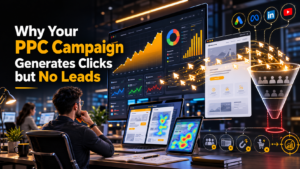
Clicks alone don’t guarantee leads—optimize the entire conversion journey.
Many advertisers celebrate when their PPC dashboard shows thousands of clicks. Unfortunately, clicks alone don’t generate revenue. If your PPC Campaign Generates Clicks but produces few or no leads, you’re paying for traffic that isn’t converting.
This situation is more common than many businesses realize. A campaign may have an excellent Click-Through Rate (CTR), low Cost Per Click (CPC), and high Quality Score, yet still fail to deliver meaningful business results.
The problem usually isn’t Google Ads itself. Instead, it’s the entire conversion journey—from keyword targeting and ad messaging to landing page experience and lead capture forms.
Understanding where visitors drop off is the first step toward fixing the issue.
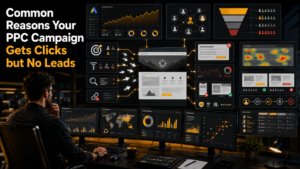
Understanding the biggest obstacles preventing PPC conversions.
If your PPC Campaign Generates Clicks but not leads, the most common reasons include poor landing pages, incorrect audience targeting, misleading ad copy, slow website speed, weak offers, or broken conversion tracking.
Every PPC campaign consists of multiple moving parts. When one component fails, conversions suffer—even if your ads attract plenty of visitors.
Here are the biggest reasons campaigns struggle to generate leads:
| Problem | Impact |
|---|---|
| Weak Landing Page | Visitors leave without converting |
| Broad Keywords | Low-quality traffic |
| Poor Mobile Experience | High bounce rates |
| Slow Loading Website | Lost visitors before page loads |
| Confusing Offer | Users don’t understand value |
| Long Lead Forms | Lower conversion rates |
| No Trust Signals | Visitors hesitate to submit information |
Many advertisers focus entirely on improving CTR. However, a high CTR simply means people are interested enough to click—not necessarily ready to become customers.
For example, a Google Ads campaign targeting “free SEO tools” may receive thousands of clicks. If the business actually sells premium SEO consulting services, those visitors are unlikely to convert.
The entire customer journey must align with user intent.

A high-converting landing page is essential for PPC success.
A poorly designed landing page is one of the biggest reasons a PPC Campaign Generates Clicks but fails to produce leads. Even highly targeted traffic won’t convert if the landing page creates friction.
Your advertisement only earns the click. Your landing page earns the conversion. Many businesses mistakenly send paid traffic directly to their homepage instead of a dedicated landing page designed around a single objective.
An effective PPC landing page should immediately answer three questions:
High-converting landing pages usually include:
Page speed is equally important. Studies consistently show that even a one-second delay in page load time can reduce conversion rates significantly, a finding echoed in Google’s own guidance on Core Web Vitals. Mobile users, in particular, are quick to abandon slow websites.
Reducing distractions, simplifying forms, and maintaining message consistency between the ad and landing page can dramatically improve lead generation.
Even the best landing page cannot convert the wrong visitors. If your PPC Campaign Generates Clicks from users who aren’t interested in your product or service, conversion rates will remain low regardless of your budget.
Audience targeting is one of the most overlooked aspects of PPC optimization. Many advertisers target high-volume keywords instead of high-intent keywords.
For example:
Low Intent Keywords
High Intent Keywords
High-intent searchers are much closer to making a purchasing decision. Another common issue is failing to add negative keywords. Without negative keywords, your ads may appear for searches that have no commercial intent, such as:
Geographic targeting also plays an important role. If your business serves clients only in specific cities or countries, showing ads globally can waste a significant portion of your budget — this is where local SEO services can help reinforce location-based intent.
Audience segmentation based on demographics, interests, device type, and previous website interactions can further improve lead quality.
Your ad copy determines who clicks on your advertisement. If the messaging is vague, misleading, or too broad, your PPC Campaign Generates Clicks from users who aren’t genuinely interested, resulting in wasted ad spend and poor lead generation.
Many advertisers assume that a higher Click-Through Rate (CTR) always indicates campaign success. In reality, a high CTR can be misleading if the clicks come from users with little or no buying intent.
For example, an ad that says “Best SEO Services – Affordable Pricing” is too generic. It doesn’t explain who the service is for, what makes it different, or why users should trust the business.
Compare that to:
“Increase Organic Traffic with Certified SEO Experts | Free Website Audit”
The second version communicates value, establishes credibility, and offers an incentive, making it more likely to attract qualified prospects.
To improve ad quality:
Consistency between the ad and landing page is essential. If users expect one thing and see something different after clicking, they are likely to leave without converting.
Without accurate conversion tracking, you cannot determine why your PPC Campaign Generates Clicks but fails to produce leads. Faulty tracking leads to poor optimization decisions and inaccurate ROI calculations.
Many advertisers focus on campaign metrics such as impressions, clicks, and CPC while overlooking conversion tracking accuracy.
Common tracking mistakes include:
| Tracking Issue | Business Impact |
|---|---|
| Missing Google Ads Conversion Tag | Leads not recorded |
| Duplicate Events | Inflated conversion numbers |
| Broken Thank You Page | Lost conversion data |
| Call Tracking Missing | Offline leads ignored |
| CRM Not Connected | Revenue cannot be measured |
| Incorrect Attribution | Wrong campaigns receive credit |
Google Ads and analytics platforms rely on conversion data to optimize bidding strategies — official guidance on setting this up correctly is available in Google’s own conversion tracking help center. If conversion tracking is inaccurate, automated bidding algorithms may optimize toward the wrong audience.
Businesses should regularly audit:
Reliable tracking provides the foundation for improving campaign performance, and pairing it with Google Analytics services gives you a fuller picture of the customer journey.
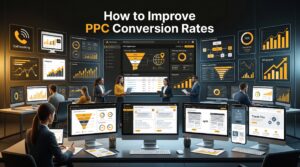
Optimize every stage of your PPC campaign to generate more qualified leads.
Improving conversion rates requires optimizing every stage of the customer journey—from keyword selection and ad copy to landing page design and post-click user experience.
Improving PPC conversions isn’t about making one major change. Instead, it’s the result of consistently optimizing multiple campaign elements.
Follow these proven steps:
Even small improvements can significantly impact campaign performance. For instance, reducing a lead form from eight fields to four often results in higher completion rates.
Continuous testing and optimization are essential for long-term PPC success.
Generating qualified leads requires attracting the right audience, delivering a relevant user experience, and making it easy for visitors to take action.
Businesses that consistently generate quality leads through PPC campaigns follow a structured optimization process, a principle also highlighted in HubSpot’s lead generation research.
Best Practices Checklist
Remember, successful PPC advertising isn’t about attracting the most clicks—it’s about attracting the right clicks that convert into paying customers.
| Challenge | Recommended Solution |
|---|---|
| High Clicks, No Leads | Audit the entire conversion funnel |
| Low Landing Page Performance | Improve page speed, design, and CTA |
| Wrong Audience | Refine targeting and add negative keywords |
| Weak Ad Copy | Align messaging with user intent |
| Poor Tracking | Verify all conversion events |
| Low ROI | Continuously test and optimize campaigns |
A PPC Campaign Generates Clicks only when your ads capture attention, but clicks alone do not guarantee business growth. True success comes from converting those visitors into qualified leads and loyal customers.
If your campaigns receive traffic but fail to generate inquiries or sales, examine the complete customer journey. Review your keyword strategy, audience targeting, ad messaging, landing page experience, and conversion tracking to identify weak points. Small improvements in each area can collectively produce significant gains in conversion rates and return on investment.
The most successful advertisers treat PPC as an ongoing optimization process rather than a one-time setup. By regularly analyzing campaign data, testing new ideas, and refining every touchpoint, you can transform wasted clicks into measurable business results and maximize the value of your advertising budget. If you’d like expert help auditing your funnel, feel free to get in touch.
This usually happens because of poor landing pages, irrelevant traffic, weak offers, slow website speed, or inaccurate audience targeting. Reviewing each stage of the conversion funnel helps identify where visitors drop off and what needs improvement.
A good PPC conversion rate varies by industry, but many successful campaigns achieve between 2% and 10%. High-performing campaigns often exceed this range through continuous testing and optimization.
The landing page is one of the most important factors influencing conversions. Even highly targeted ads can fail if visitors encounter slow loading times, confusing messaging, or difficult forms.
Yes. Negative keywords prevent ads from appearing for irrelevant searches, reducing wasted spend and increasing the likelihood of attracting users with genuine purchase intent.
Conversion tracking measures the effectiveness of your campaigns. Without accurate data, it's difficult to optimize bids, evaluate ROI, or understand which ads and keywords generate valuable leads.
Campaigns should be monitored weekly and optimized regularly. Reviewing search terms, adjusting bids, testing ad copy, and refining landing pages help maintain strong performance over time.
Generally, no. Dedicated landing pages tailored to the ad's message provide a more focused experience and typically achieve higher conversion rates than general homepage traffic.
Use high-intent keywords, refine audience targeting, create compelling ad copy, optimize landing pages, simplify lead forms, and regularly analyze campaign performance to attract more qualified prospects.

Gaurav Madan, Founder and CEO of Autus Digital Agency, is a pioneering figure in digital marketing with experience of 20+ years. His expertise revolutionizes online marketing strategies and leverages digital platforms for business growth. Gaurav’s consumer-centric approach and strategic vision propel diverse industries to position online presence and dominate.

SEO is one of the most effective long-term digital marketing strategies, but it rarely delivers overnight success. Many website owners become frustrated because they expect immediate improvements after publishing optimized content or fixing technical issues. In reality, successful SEO is measured through gradual improvements across multiple performance indicators rather than a single metric. So, how […]
.....
Duplicate content is one of the most common technical SEO problems affecting websites of all sizes. It occurs when identical or highly similar content appears on multiple URLs, making it difficult for search engines to determine which version should rank in search results. While Google generally doesn’t apply a direct penalty for duplicate content, it […]
.....
A sudden decline in Google traffic can be one of the most stressful situations for any website owner. A website that previously generated consistent visitors, leads, and revenue may suddenly experience fewer clicks, lower rankings, and declining visibility in search results. However, a traffic drop does not always mean a website is permanently damaged. With […]
.....
Artificial intelligence has fundamentally changed how people discover information online. Instead of clicking through multiple search results, users increasingly rely on AI-powered assistants like ChatGPT, Google AI Overviews, Gemini, Claude, Microsoft Copilot, and Perplexity to summarize answers instantly. This shift has introduced a new phenomenon known as Ghost Citations. Your research, statistics, definitions, or insights […]
.....
Creating a successful B2B SaaS marketing strategy has become more challenging than ever. With increasing competition, longer buying cycles, AI-powered search experiences, and evolving customer expectations, SaaS companies need far more than a great product to achieve sustainable growth. A modern strategy combines SEO, content marketing, product-led growth, demand generation, paid advertising, marketing automation, customer […]
.....
The pharmaceutical industry has become increasingly digital, with healthcare professionals, patients, and researchers relying on search engines to discover medications, treatment options, clinical research, and healthcare providers. As competition intensifies, pharmaceutical companies need specialized SEO strategies that not only improve search visibility but also comply with strict healthcare regulations. Unlike general SEO agencies, top pharmaceutical […]
.....
If your auto repair shop isn’t showing up when potential customers search for terms like “brake repair near me” or “oil change in my city,” you’re likely missing valuable business every day. Most vehicle owners turn to Google before choosing a mechanic, making your online visibility just as important as the quality of your services. […]
.....
Finding trending topics is one of the most effective ways to create content that attracts readers, ranks higher in search engines, and gains visibility across AI-powered platforms. Whether you’re a blogger, SEO professional, marketer, or business owner, understanding what people are searching for helps you publish content at the right time and stay ahead of […]
.....
Businesses have spent years optimizing websites for Google Search, but AI-powered search experiences are changing how people discover brands. Millions of users now ask ChatGPT, Microsoft Copilot, Gemini, Claude, and Perplexity for recommendations instead of browsing search results. These AI assistants summarize information from trusted sources, making it essential to understand whether your business is […]
.....
Search has entered a new era. Instead of presenting users with a list of web pages, AI-powered search engines now provide direct, conversational answers. Platforms such as Google AI Overviews, ChatGPT, Gemini, Microsoft Copilot, Claude, and Perplexity are changing how people discover information online. As a result, businesses can no longer rely solely on traditional […]
.....
Search behavior has changed dramatically over the last few years. Instead of relying only on traditional search engines, users now seek authentic discussions, real-world experiences, and community-driven recommendations before making decisions. This shift has transformed Reddit from a discussion platform into one of the most influential sources for search visibility. Today, Google frequently ranks Reddit […]
.....
Search engines have transformed dramatically over the past two decades. Early search engines relied heavily on matching keywords, backlinks, and page authority to determine rankings. Today, artificial intelligence is redefining how information is discovered, interpreted, and delivered. Instead of simply displaying a list of blue links, modern AI-powered search engines analyze user intent, understand context, […]
.....
How to Sell on Amazon: The Complete Guide (2026) Selling on Amazon is among the top approaches known today to start up an online business. Amazon has millions of buyers visiting every single day looking for products in all kinds; you can sell anything on Amazon. This provides new sellers a wonderful opportunity to continue […]
.....
Google Search Console — never a better SEO tool for website owners and marketers. It enables better insights into how your website is performing, tracks clicks and impressions on search engines for relevant queries, and offers valuable indexing information. In addition to Search Ads 360, Google has now rolled out reporting for social and video […]
.....
Google Lighthouse has long been one of the most trusted tools for developers, SEO professionals, and website owners because it evaluates website performance, accessibility, SEO, and overall quality. In 2026, Google introduced a new Lighthouse category called Agentic Browsing, reflecting the growing role of artificial intelligence in web interactions. Unlike traditional search crawlers that mainly […]
.....
Why You Need to Spot Fake Online Reviews The buy-before-buying: where to eat, which service to choose — people make all choices based on online tips. Before spending their money, most people read reviews. Good reviews instil trust in the mind; bad reviews force users not to buy. But not every review is real. Whatever […]
.....
Google reviews are one of the most important parts of local SEO. They help businesses build trust, improve local rankings, and attract new customers. Recently, many business owners noticed that some Google reviews suddenly disappeared. This created confusion and concern, especially for local businesses that depend on customer feedback. In most cases, Google is not […]
.....
The impact of your online reputation and perception on you/your business cannot be understated. Unwanted search results on Google can affect the trust of an individual, a professional body or company and can even lose business opportunities. Whether its news post or bad review, even an irrelevant page, removal or suppression of harmful search results […]
.....
In 2026, your online reputation is one of the most important digital assets. If you have a company, working freelance, creating the startup you will want to build a personal brand and earlier than that people will be searching online before making decisions. They read reviews, look at your website, visit social networks and consider […]
.....
Selling products online has become one of the best ways to build a business. Among all eCommerce platforms, Amazon stands out because millions of customers visit it every day. Whether you want to sell handmade items, private-label products, or branded goods, opening an Amazon store can help you reach a massive audience. The good news […]
.....


